
Last year, the Trump administration made slashing the federal government’s office footprint a centerpiece of its cost-cutting campaign.
But the savings have yet to show up in the government’s rent bill.
A new TRD Data analysis of U.S. General Services Administration records found that the federal government’s annual rent obligations were essentially unchanged through May, despite hundreds of lease terminations touted by the Department of Government Efficiency, or DOGE.
The U.S. rent bill was $5.78 billion annually in rent when President Trump took office. As of May, that figure had ticked up .5 percent.
DOGE, which was disbanded last year, aggressively targeted the GSA, which handles workspace for more than 1 million federal employees. GSA does not manage all of the federal government’s real estate holdings. DOGE claimed credit for tens of millions of dollars in rent savings through lease terminations, but the figures published on its “Wall of Receipts” shifted repeatedly.
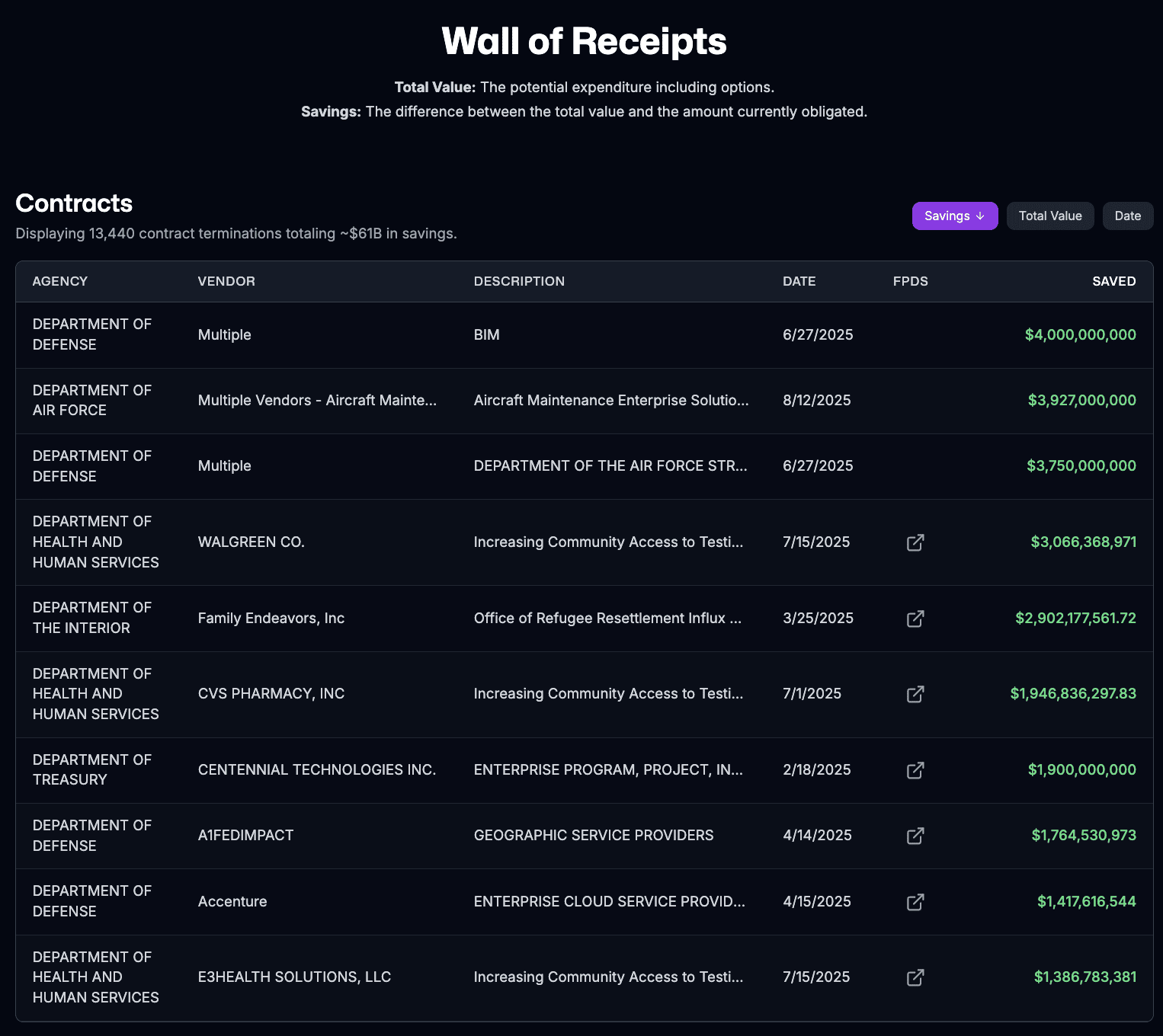
In February 2025, DOGE reported more than $144 million in lease-related savings, according to a TRD Data review of the “receipts.” The most recent version of the site, last updated in January, says DOGE saved about $113 million across 264 lease terminations. However, the “savings” column on the site totals just $53.5 million.
“GSA remains focused on supporting this administration’s goal of optimizing the federal footprint and providing the best workplaces for our federal agencies to meet their mission,” a GSA spokesperson said in a statement.
GSA did not respond to a question about the discrepancy in values.
While the dollar value of the government’s leases edged higher over the past year, the number of leases fell by about 2.2 percent, or 165 leases. Total leased space declined 1.1 percent to roughly 171.6 million square feet.
Subscribe to TRD Data to unlock this content
Terminating a federal lease is often a lengthy process, particularly for larger offices in major cities, according to Darian LeBlanc, who leads Cushman & Wakefield’s Government Services Group and works with landlords and investors who rent space to the government.
“There’s very little current activity,” LeBlanc said. Rather than signing new leases, agencies appear to be focused on determining what they want their long-term real estate footprint to look like.
Government agencies may be reassessing their real estate needs rather than rushing to shed space, according to Jeanne Davis, a government transactions account director at JLL who represents the government in leasing deals.
“We’re seeing the government look at all options,” she said. “Everything’s on the table, it seems.”
The GSA has been slowly reducing its rentable square feet over time. Since 2018, the organization has reduced its footprint by some 9 percent.
To this end, DOGE did contribute to some lease trimming, though far less than it claimed.
TRD Data matched DOGE’s list of cut leases to GSA’s leasing data using the leases’ cities, square footages and annual rents and found 177 leases that are on both lists, short of the DOGE’s full accounting of 264 leases.
Of the matched leases, 159 are no longer on the government’s rent roll, representing about $70.1 million in annual rent saved. However, about 48 percent of those leases were set to expire before May, regardless. Meanwhile, another roughly 20 leases that DOGE planned to cut remain on the books, totaling $5.5 million in rent a year.
However, despite DOGE’s efforts, the government’s rent continued to climb. Since the start of February 2025, the government moved forward with 433 leases that add up to about $245 million annually, per an analysis of GSA’s data.
Lease planning and signing, along with building out a large space, happens months, if not years, in advance, the experts said, underscoring just how challenging it can be to halt such plans in their tracks.
It is possible that savings from DOGE will materialize in the future. Roughly 89 percent of the leases the government holds have termination dates from 2027 through 2046.
While most of those leases will likely be renewed, it’s unclear how many are on the chopping block. This is particularly the case as there are many aging facilities that need heavy repurposing to fit the needs of today’s workers — without wasting money, said Creighton Armstrong, national director of JLL’s Government Advisory Group, who leads teams that represent government agencies in their leasing activity.
“I do think it’s refreshing that we’re not just doing the same thing over and over and over again,” he said. “People are taking hard looks at where the world of work is going in the future and [asking,] are these assets making sense for us?”