The Real Deal New York

Posts Tagged ‘neil binder’

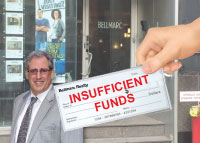
  • Raveis-Bellmarc deal scuttled

    May 10, 2011 01:38PM
    alternate text
    From left: Neil Binder, president of Bellmarc, and Chris Raveis, managing partner of William Raveis

    The planned purchase of a large stake in Bellmarc Realty by William Raveis Real Estate, which would have been one of the larger real-estate acquisitions in recent memory, is dead.

    Neil Binder, Bellmarc’s president, confirmed today to The Real Deal that during negotiations in recent weeks the two sides could not bridge their differences about how a brokerage should be run.

    “As we continued to progress on trying to create a framework for marriage, it appeared to both sides that we had different business models,” Binder said, without elaborating about whether the disagreement was over price or how the combined company might function on a day-to-day basis. [more]

  • alternate text
    Two photos on left are of 250 East 68th Street, other two property shots are 124 DeKalb Avenue in Fort Greene, and Spike Lee

    alternate text

    A former firehouse at 124 DeKalb Avenue in Fort Greene housed Spike Lee’s production company for years — until a dispute with the landlord got in the way. Now that Lee’s Forty Acres & a Mule Filmworks has relocated around the corner, fans of the famous filmmaker can purchase the DeKalb Avenue building for a cool $3.9 million. Also, Neil Binder, co-founder of Manhattan real estate brokerage Bellmarc, has placed his newly constructed five-story glass and stucco townhouse on the market for $9.5 million. The 17-foot-wide house, located at 250 East 68th Street between Second and Third avenues, is listed with Lisa Strobing, an executive vice president at Bellmarc. Click here for more.

    [more]


  • From left, Neil Binder, Wolf Jakubowski and Jonathan Miller

    From the November issue: The beleaguered luxury real estate market in New York is beginning to show some positive signs, but there is expected to be a lot of stumbling along the path to recovery. The high-end market here has been harder hit in terms of both price drops and activity than any other sector, and there’s still a sense of nervousness among many about buying multimillion-dollar properties. However, in this month’s Q & A, The Real Deal talked to market analysts, top luxury brokers and heads of firms who said that while there is still a lot of caution, they are beginning to see a mild increase in activity in Manhattan’s most exclusive property trades. Within the last two months, some say they have noticed an increase in buyers, who for the first time in the last year are not convinced that prices will continue to go down. But sales are still way off, and one analyst disputed the notion that prices are going to head back up anytime soon, saying “inventory is still grossly overpriced for the current conditions.” Meanwhile, many of the transactions that have taken place are from all-cash buyers who are paying lower prices, or from buyers who are putting in at least half of the cash needed to finance the purchase. That means the jumbo mortgages that drive the segment are still not getting easier to obtain — a reality that does not bode well for the sector in the near future. And many of those interviewed said sellers are still not dropping their prices to the levels they need to be at to lure buyers. They said the $2.6 million to $5 million range and the $10 million to $20 million range have suffered most. For more on what’s going on, which areas of Manhattan have seen the largest drops in the luxury sector and which ones are holding stronger, we turn to our panel of experts.

  • alternate text
    From left: Diane Levine of Sotheby’s International Realty, 168 West 73rd Street, Neil Binder of Bellmarc Realty

    While a significant portion of listings — roughly 33 percent,
    according to Streeteasy.com — saw price cuts last month, there was an
    increase in sales and many brokers started elevating asking prices to
    enhance their units’ image, to leave room for haggling or because they
    thought the market was turning around. Upwards of 850 homes in Manhattan sold in August, according to figures compiled by The Real Deal
    using Streeteasy.com data, up from approximately 760 deals made a month
    prior. Almost 5 percent of all Manhattan homes on the market last
    month, the data shows, saw price increases; those price changes
    averaged 6.4 percent. And those price increases were seen across the price spectrum. [more]

  • From the September issue: For a year now, real estate brokers and developers in New York have
    been grappling with the ripple effect of the Lehman Brothers collapse
    and the Wall Street fallout. But now, on this somewhat somber
    anniversary, it’s time to start looking ahead and anticipating where
    the market will be a year from now.
    In this month’s Q & A, The Real Deal talked to
    economists, brokers and firm principals who described what the
    landscape will look like for sales activity, pricing, foreclosures and
    employment in the next 12 months in the city. The predictions were not
    all pretty.
    Indeed, one economist said that prices will have dropped another 13 percent by next September. more

  • Neil Binder, co-founder of Bellmarc Realty and author of four real estate books, sat down with The Real Deal to
    talk about the market, cutting costs at the firm to survive the
    downturn and how a cheating girlfriend got him into the real estate
    business. 

    There are tons of predictions about when the market will bottom. Do you have one? Yes, and mine is the right one. (laughs) It already has. There are
    three [economic] states that economists talk about: one is an L — we
    go down and we stay down, one is a V — we go down and we pop up and
    the W — we go down, we go up, we go down, we go up. I truly believe
    [this] will be a W.

    How are you trying to cut costs? We closed our main location,
    we consolidated staff, we repositioned our advertising a little bit and
    made cuts wherever we could make them and still be able to service
    customers. Nothing was sacred. I think we were the first ones to get
    out there and start doing things and everybody said ‘Oh, Bellmarc’s in
    trouble, Bellmarc’s going down, Bellmarc’s bankrupt.’ I’ve been in
    business 30 years, and for at least 20 of them, someone has told me I’m
    going bankrupt. We just had our 30th anniversary. [more]