

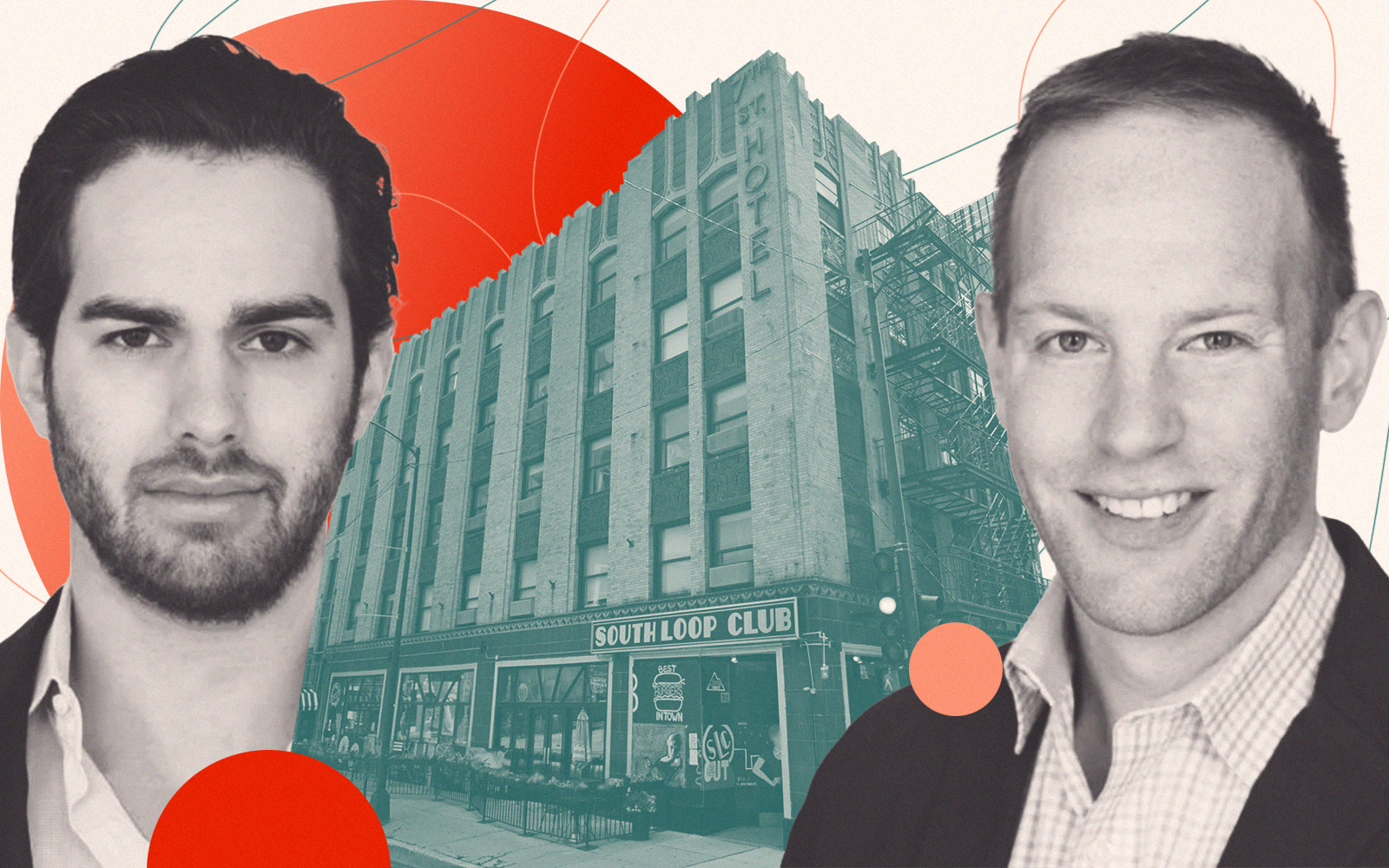
Before buying prime Chicago real estate, Noah Birk, Aaron Sklar and Dan Gonzalez made their names selling it.
As a top-producing investment sales duo for Chicago-based Kiser Group, Birk and Sklar dominated Chicago’s South Side multifamily market, with Gonzalez as the brokerage’s COO. In 2021, following a historic year for the broker pair in which they closed 73 sales totaling $146 million in overall sale volume, the trio came together to form BSG to focus on their investment purchases they’ve made on the side of their brokerage business.
Though they started small, they’ve since scaled their ownership to a portfolio of about $70 million in Chicago-area property, judging from the total they’ve paid for their more than a dozen properties, even while navigating a little controversy tied to their brokerage business. They’re also trying their hands at development, investing as joint venture partners into a Fulton Market project of more than 70 units being spearheaded by Range Group as the lead builder, with construction set for completion this summer.
But their ascent from brokers to investors wasn’t without friction. The trio’s transition directly mirrors a turbulent, high-stakes shift in the very South Side neighborhoods they fashioned into a magnet for capital from across the nation that are now dealing with upticks in financial distress.
Plus, there’s a delicate balance to strike for brokers who invest in the same property markets they also list for sale, as it can open the door for potential clients to question why the broker wouldn’t buy a listed deal with his or her own capital.
But Sklar doesn’t see it that way, claiming BSG’s activity proves he has the same amount of conviction in Chicago’s multifamily scene that he pitches to other investors for Kiser.
“We’re putting our money where our mouths are,” he said. BSG paid $6.2 million Monday for its most recent purchase of 1552 North LaSalle Drive, a 16-unit property that recently was gut-renovated with condo finishes in the heart of Old Town.
The seller was prominent Chicago-based investment firm JAB Real Estate, led by Frank Campise and Jim Jann, who extended their selling streak to $120 million worth of Chicago real estate over the last two years, countered by one $35 million Fulton Market acquisition they made from Waterton at a discount to the property’s last sale price. JAB has other purchases on the horizon, including some development site deals in the North Side and near the lakefront on the South Side, Campise said.
“The reason we sold to these BSG guys is that they’re good buyers, they performed,” Campise said. “Some of the enthusiasm, or as Alan Greenspan once put it, ‘irrational exuberance’ around rent growth makes now a good time to sell.”
Out-of-state frenzy fallout
Birk and Sklar were at the vanguard of the South Side multifamily boom, successfully pitching coastal investors on the area’s alluring cap rates, which sometimes reached double-digit figures to dwarf compressed national averages of around or below 5 percent a few years ago.
Tasked with securing the highest and best price for their sellers, the brokers executed the mandate, helping to drive pricing to levels that had many local investors raising eyebrows. By 2024, inflation-adjusted DePaul University data showed per-unit prices in Chicago’s lower-cost multifamily neighborhoods surged to nearly $73,000 per door, up from less than $60,000 in 2019.
However, with higher cap rates comes more risk for buyers. As out-of-state capital flooded into the South Side, a wave of artificial valuation and severe distress began to swell.
Perhaps the most explosive collateral damage involved Wisconsin-based landlord Trinity Flood. A few months after purchasing an $18 million South Side portfolio listed by Birk and Sklar, Flood, after determining she overpaid, accused seller Daniel Hedaya of DAX Real Estate and the Kiser Group brokers of impropriety during the marketing process. Flood alleged she was misled about capital improvements, claiming she was promised fully renovated properties only to find dozens of units untouched, alongside undisclosed, mandatory 24-hour security costs totaling $15,000 a month.
Though the parties reached a confidential legal settlement in October 2023, the underlying distress culminated in 2025, when the portfolio fell into a $27 million foreclosure lawsuit, and later one of the central assets at 7500 South South Shore Drive was dramatically raided in the middle of the night by federal law enforcement during the “Operation Midway Blitz” immigration crackdown.
The legal scuffle left the brokerage team unscathed. But the visual of federal agents arresting 37 people at a property they had once touched sent shockwaves through the market. Reflecting on the macroeconomic fallout of the area’s speculative era, Birk last year told The Real Deal:
“That obviously isn’t a great look on the South Side, but there’s a million other buildings where things are going great and the neighborhoods are feeling vibrant.”
Rent growth winding down?
Having witnessed some investors become doomed by overpaying based on flawed spreadsheet formulas and neglecting field operations, the BSG trio engineered a different blueprint for their own ten-figure firm.
Instead of chasing inflated unit counts on heavy-lift, high-vacancy properties, BSG weighted its portfolio toward stabilized, recently renovated buildings and boutique new construction commanding durable demand. As Birk put it, they’re not hunting discounts on real estate for taking on fixer-uppers.
“We’re not necessarily getting great deals. We’re paying market prices,” he said.
While maintaining disciplined selections on the South Side — such as a 30-unit gut rehab overlooking Lake Michigan at 7520 South South Shore Drive — BSG also diversified into North Side and West Town submarkets, as well as into northwest Indiana, where it owns a couple properties in Whiting.
Yet Campise is cautioning that the explosive 5 percent to 8 percent annual rent growth metrics that have Chicago leading the nation amid a drought in new development won’t continue. Even as he remains bullish on Chicago development while lining up some of his own plans to bring new supply to the market, he’s convinced institutional investors are set to return to funding Chicago construction at a pace that will temper apartment rent hikes in the near future.
“If people are enjoying healthy margins, other people want in. That’s what we’re starting to see now in the city,” Campise said.
He attributed the city’s rising profile as a multifamily market to recent changes in the elected leadership of both Cook County’s State’s Attorney and Assessor offices, which respectively helped to bring more predictability to crime and, expectedly, property taxes in Chicago. (Eileen O’Neill Burke won the State’s Attorney’s office for a term that started in December 2024 while Patrick Hynes unseated incumbent Assessor Fritz Kaegi in the Democratic primary earlier this year, with Hynes expected to win the office in November’s general election.)
“People will rush in because they see the margins now,” Campise said. “What will happen is because Chicago’s Affordable Requirements Ordinance requires 20 percent of new units to be affordable, the math would require many of these projects to have rents that I don’t believe will be achievable. Rents will moderate, and some projects will not be good projects. You’ll see supply pull back again as some of these coming new development projects will suffer, and we’ll go back to having a more dislocated market,” Campise said.
Read more

Commercial
Chicago
Stuart Handler sells Hyde Park multifamily portfolio for $23M
Commercial
Chicago
South Loop Club building changes hands for $6M

Commercial
Chicago
Midmarket sales stand out in Chicago’s bustling multifamily scene