

Brian Steinwurtzel’s grandfather built a real estate dynasty turning old West Side warehouses into office buildings.
Some seven decades later, Steinwurtzel is following the family tradition by converting outdated office buildings into apartments.
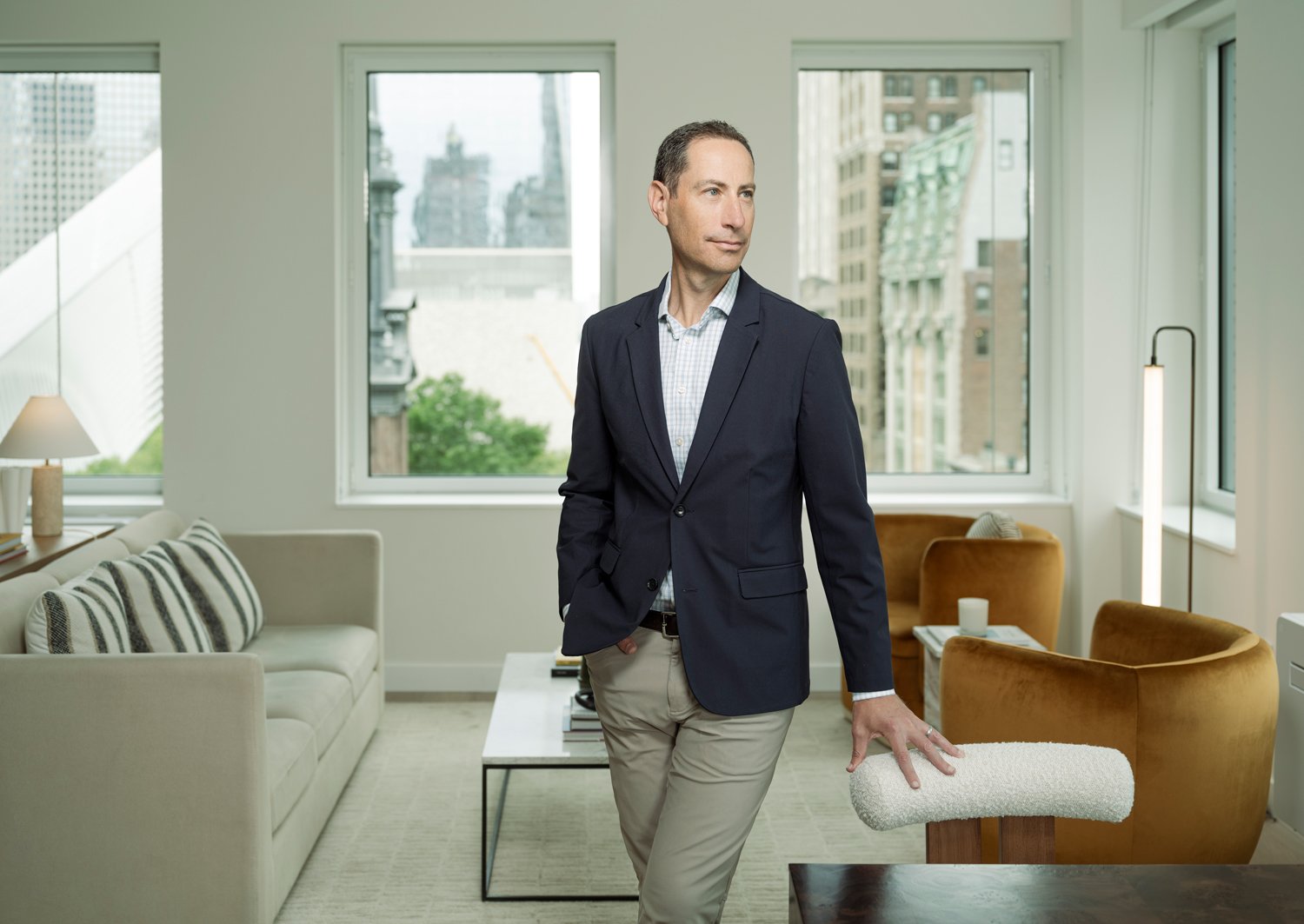
The 49-year-old has been heading up GFP Real Estate’s developments for the past 13 years. In April, the Gural family spun out the resi-conversion side of the business into GFP Development, naming Steinwurtzel the new entity’s CEO.
In recent years, he’s run projects like SoMA — the conversion of the Brutalist-styled 25 Water Street office building into 1,300 rental apartments. He’s also turning the 31-story office tower at 222 Broadway into 788 units. Late last year, New York City selected GFP to convert the city-owned site at 100 Gold Street into 3,700 apartments.
That constant rebirth of what’s old into something new is in Steinwurtzel’s DNA. His grandfather, Aaron Gural, got his start in real estate reading water and electric meters during the Great Depression for Spear & Company, a firm owned by his uncles (Steinwurtzel’s great-great uncles) before turning to a career as a broker. He later bought Newmark & Company, helping build it into the $2.5 billion giant it is today. In the 1950s, he started amassing old manufacturing buildings and converting them to offices.
The family’s portfolio includes the Film Center Building at 630 Ninth Avenue, the DuMont building at 515 Madison and the iconic Flatiron Building — which the Gurals are teaming up with the Brodsky Organization to convert into condos following a bizarre episode in which a relatively unknown investor named Jacob Garlick tried unsuccessfully to buy the building at auction.
When the time came, Aaron handed off the business to his son, Jeff Gural. And in 2013 Jeff appointed Steinwurtzel, his nephew, and his son, Eric Gural, as co-CEOs.
Together, they oversee a portfolio measuring about 13 million square feet, mostly in Manhattan.
Steinwurtzel sat down with The Real Deal to talk about family dynamics, converting office buildings and certain family members with a killer instinct.
This interview has been condensed and edited for clarity.
Born: April 16, 1977
Hometown: Washington, D.C.
Lives: Hastings-on-Hudson, New York
Family: Married, two children
“With more people, there’s more mouths to feed.”
Your family’s one of the biggest owners of Class B office buildings in New York, which puts you in the eye of the office storm. What’s that like?
My uncle’s probably the better person to ask the question to, but my sense from our quarterly meetings is that things are coming out the other side from Covid. It’s still a struggle. One of the big challenges is that rents may be recovering back to pre-Covid levels, but the cost to run the buildings is significantly higher.
How do things work between you and your uncle?
He’s been great at helping me open doors and introducing me to individuals when we have an idea or we need to help solving a problem. He’s probably faced the same problem at some point in his career, so it’s good to hear how he’s approached it in the past.
And then he’s a very trusted person in the community, in government, in our industry — so he’s someone that can help in these conversations to allow people to trust us. He’s not involved in any of the day-to-day on our development projects or acquisitions, but he’s always there if we need him.
What do you think of the Flatiron conversion? Can you tell us any good Jacob Garlick stories?
It’s a strange, strange thing to have somebody who obviously couldn’t afford to buy a building to actually show up and go through that process.
[Garlick] will forever be famous for that, and I don’t think that’s what I want to be known for, but everyone has their reasons.
Dan Brodsky and his team have done really an extraordinary job. Dan and my uncle have a decades-long relationship and trust each other implicitly, and I’m really happy that we partnered with them to do it. It’s really turned out well, and it seems that the market feels the same way. It’s a little bittersweet for our family, because we’ve been in the building for so long, but I’m happy that there will be people who actually get to live in it.
You are one of the biggest landlords to small companies in Class B buildings. How’s that different from dealing with big corporate tenants?
They’re really different businesses. When you’re working with small- and medium-size businesses, it really is these individuals’ lives — the thing they spend the most time on, and it’s a very personal experience. They have the same expectations, if not more, than a Class A corporate tenant, because their livelihood depends on you.
How did you get your start in the family business?
When I was 16, I lived with my aunt for a summer and worked at Newmark. I worked with my cousin who was running our Garment Center portfolio, and my job was to collect rent in a lot of the manufacturing buildings.
That was 1992 or 1993 and it wasn’t a great economy. When you went to collect the rent, they were trying to decide which bills they could actually pay and you would hear a lot about them, their families, what was going wrong. You learned a lot about how personal it is. It’s not just business.
Steve Witkoff carried around a gun when he did collections. Was it like that?
I fortunately was unscathed in my experience collecting rent. But it was very uncomfortable when you would get handed an envelope or a bag of cash, and you had to go very quickly back to the office and give it to the people who knew how to handle that. It was not fun to know that you had 20- or 30-thousand dollars in your pocket, especially in 1993.
How did your immediate family end up in D.C.?
My mom and my dad met in college and then my dad got into George Washington University Law School. My mom ended up getting her MBA at G.W., as well, and they ended up staying.
What was it like then? I heard you got mugged once.
D.C. was like the murder capital of the country growing up. The Washington Post had a murder count that would increase every day. If you went out even in Georgetown or Adams Morgan and you’re out late, then there’s a good chance you might run into some trouble — and I did.
So much of real estate is about public safety. Did that have an effect on you?
Most major cities have done a great job of turning things around. And, for better or worse, most young people don’t understand what it felt like to be in a city. I lived in Chicago in an area of Lincoln Park that was sort of on the fringe of where development was happening. I was mugged there, at gunpoint, and that’s something that you won’t forget.
You have this real estate connection in New York, your dad was a lawyer and your mom had her MBA. Were there expectations for what you would do?
None. My parents were great. They wanted me to be me. I did not want to work in real estate because my first memories of the family business were from the late ’80s and early ’90s when the market crashed. There were a lot of arguments about having to support buildings that weren’t making money, and my grandfather stepping in to guarantee a lot of loans to help save the portfolio. I loved technology — I still do — and I ended up focusing on that in college and the jobs that I took before going to business school.
When you did the real estate program at Columbia, you had a lot of notable people in your class.
I got really lucky about who I was sitting with: Jeremy Shell is a good friend; he runs TF Cornerstone. Jessica Elghanayan was in our class as well. Actually, they met at Columbia and got married afterward. Philippe Visser has a very big job at Related, running office nationally. Erik Horvatt runs Olayan.
What’s it like having that network?
So many people that I’ve met through Columbia I can call when I’m in a tough spot. Every one of them answers that call and gives me advice or helps me through it without asking for anything in return, and I do the same back to them.
When you and your cousin took over the business, you said there was a mandate to grow. Where did that come from?
We have a lot of people in the third generation and fourth generation, and I think it will hopefully continue to grow. And with more people, there’s more mouths to feed.
Can you tell me a little bit more about the new business, GFP Development?
Our legacy portfolio will continue to be run just as it has for the last 75 years, and Jeff will run that. The development business is different; there’s a significant amount of risk that we take on. These projects are very large. We had mostly institutional partners in them, and culturally they’re really different businesses. The family believes in both of them, and they want them both to succeed, but having them as two separate businesses ultimately is the best path for both to be successful.
You’re doing a lot of office-to-resi conversions and you’ve said that the biggest challenge with these projects is time. How does that play out?
At SoMa, we borrowed $500 million. Let’s say our effective interest rate was 10 percent. You’re spending $50 million a year in interest, and you can do a calculation on what that is per day. We would have conversations where someone would have an idea that could save $500,000 by doing something slightly different, which is great. We always want to save money. But if that added to the schedule by two weeks or longer, it wouldn’t be worth doing.
“There’s definitely members of my family that have what I call the killer instinct, and they have to win. I like to win. I want to win. I don’t have to win.”
How did you meet your wife?
We met the old-fashioned way: the bar. A place called Sullivan Room, which was a fancy lounge that a friend of mine was promoting. I looked up and saw this woman across the bar who was beautiful and she was drinking a beer. So I put down my fruity drink, bought a beer and went over to her and said, “You know, you and I are the only two people drinking a beer, there must be something we have in common.” And that was it.
What is the biggest risk that you’ve taken?
We bought what was New York Plaza that we turned into SoMa, 25 Water, in the depths of Covid with interest rates spiking, inflation off the charts and a downtown that nobody wanted to be in. [It’s] a building that had almost no windows in it, and [we] acquired that from three German lenders.
What do you do for fun? I heard you race cars sometimes.
I used to do what they call autocross racing. It’s basically where these car clubs go to, let’s say, MetLife Stadium, and they set up a de facto race track with cones. But you rarely get above like 60 or 70 miles an hour. It’s much more about maneuvering and time. It was fun to do on weekends and it was good to have an outlet to explore.
Are you an adrenaline junkie?
Not anymore. As a kid I used to like roller coasters. I used to like car racing — generally things that went fast. There was a small moment in my life where I wanted to potentially fly planes. I’m older now and, unfortunately, I feel like I’ve lost a lot of that.
And you play tennis.
My wife and I are both athletes. I play golf in the winter, we play a lot of outdoor paddle tennis, but pretty much anything with a ball, a racket, a stick, whatever.
There are two guys that recognized that there were a lot of tennis players having a hard time finding each other, and they set up this tennis ladder. I don’t know if they thought there’d be 20 or 30 of us, but now they have hundreds and hundreds of people that have signed up. They’ve done a good job building this interesting culture in Westchester around tennis, and then they have these events throughout the season where they’ll have weekend round robins and a big tournament at the end of the year.
Are you competitive about it? Is it enough for you to just go out and break a sweat, or do you need to win?
No, I don’t. There’s definitely members of my family that have what I call the killer instinct, and they have to win. I like to win. I want to win. I don’t have to win.
Do you think about leaving a legacy behind?
I don’t think most people will be remembered beyond their family, and even their family unfortunately won’t remember them after three or four generations. What I hope is that the people I interact with, I’m somehow leaving them better off in some way, or impacting their lives in a positive way.