

Teresa Troyer bought her three-bedroom townhome in a Central Florida subdivision five years ago, expecting homeowners to decide how their community is run.
But she said it’s clear to her who’s in charge — the developer, not homeowners.
Florida law mandates developers pass on control of residential associations — most visible in the ability to elect their boards of directors — to homeowners when developers sell the majority of planned homes.
The reality at the Portofino Vista complex in St. Cloud is more complicated. About two decades ago, the developer planned 262 townhomes. Since then, it’s completed 57, leaving the remaining lots vacant and the developer at the helm of the association, with its employees sitting on all three board seats, according to records.
Under their leadership, the Portofino Vista HOA has neglected property upkeep, yet still levies assessments, Troyer claims.
“What 57 families at Portofino Vista are experiencing is not an HOA dispute,” she said. “The structure extracts money from 57 homeowners without any financial transparency whatsoever.”
She and her neighbors aren’t the only ones who feel this way. Across Florida, cases have emerged where homeowners allege the developers of their buildings retain power of condo-, homeowners- and master associations. Experts say this goes against the spirit of state law and what residents count on when they buy in. The implicit bargain is straightforward: developers build, sell and step back.
“What [developers] are selling to residents on and saying is, ‘You, too, can get to be on the board,’” said Travis Moore, a Florida association law expert and lobbyist. “Well, if you never give up control, you’re not keeping your end of the bargain.”
Exactly why some developers remain on boards and how widespread the problem is remain unclear. The Real Deal identified five complexes where allegations of continuing developer control of boards has popped up. Many other cases claim developers stepped back from boards but retain power in other ways, including final say for associations to obtain loans or charging residents for amenities or parking.
State law grants exceptions that allow for long-term developer control, but those are few.
Association law experts theorized that where developers outstay turnover timelines, it may be because it serves them. It lets them keep contractor relationships intact, delay construction defects lawsuits commonly filed against developers after turnover, or continue reaping profits by having their affiliates stay on as community managers and keeping contracts in house. At condos, developers also may delay turnover because they failed to meet the legally required reserve funding, experts said.
Control also makes it easier to redevelop parcels in the future while immobilizing homeowners from pushing back as a collective organized under an association with its own budget, including for attorneys, the experts said. At some complexes, homeowners contend the developer-controlled association strapped them with high assessments, threatening liens and foreclosures against those who refuse to pay, according to suits.
“It’s a tremendous amount of power,” said attorney Jason M. Rodgers-da Cruz. “So why would the developer relinquish that right when that association entity gives them the power to assess and sue?”
The world of associations is rife with conflict. But most of it emerges after turnover, when homeowners take aim at their neighbors serving on boards and at community management firms, alleging election fraud, plundering of association coffers –– some leading to massive criminal cases –– and retaliation against those who speak out. The issue of developer-controlled boards hasn’t been a common flashpoint, but more of an undercurrent when residents face pressing problems: hefty assessment hikes, neglected maintenance, parking shortage or unresponsiveness to inquiries, including for financial records, according to lawsuits and interviews.
The largest known such case is playing out in Brickell Key, where developer Swire Properties has controlled the master association since the 44-acre man-made island was built in the 1980s, according to a lawsuit filed in May. Condo owners allege Swire –– whose employees sit on all three board seats –– used that control to saddle them with a $32.3 million assessment for a seawall and baywalk they neither own nor share as common area. They contend the seawall replacement may be tied to Swire’s planned Mandarin Oriental-branded condo and hotel on a portion of Brickell Key.
Many of the developers accused of outstaying their welcome counter they’re in their full right and have done nothing illegal, wrong or out of the ordinary.
Not everyone is convinced.
“Developers aren’t keeping things because of the goddess of their heart,” Moore said.
The law
Under the condo act, once a developer sells 15 percent of units, homeowners can elect a third of board members, usually three or five people. They get to elect a board majority three years after 50 percent of units are sold, three months after 90 percent are sold, or if a developer halts construction or is no longer listing units for sale.
The condo act has a rigid turnover deadline at seven years.
The HOA act is weaker: It has no such hard deadline and says homeowners elect a board majority once 90 percent of parcels in all planned phases are sold. It covers townhome and single-family complexes, as well as master associations for communities with condos and commercial spaces –– such as Brickell Key, which includes offices –– or those with a mix of condos, townhomes and single-family homes, according to attorneys.
Developers also can make their own rules. In governing documents –– articles of incorporation, bylaws, covenants and declarations –– created in the early stages of a project, some lock in their power.

Brickell Key’s 1981 governing documents give Swire “sole authority” to appoint master association board directors, allotting it two votes for each vote by a unit owner, according to residents’ lawsuit, which contends that under state law, turnover should have happened in 2014 when the last condo building developed on the island was conveyed to residents.
Although attorneys not involved in the case said it’s reasonable for a developer to keep control if it plans redevelopment of portions of Brickell Key, the law doesn’t validate permanent power.
“Public policy in Florida does not support perpetual control of a master association by the developer,” said attorney William Sklar. “That’s like saying, ‘I sold everything out but I know what’s good for you.’”
But it’s difficult to fight off governing documents’ clauses that grant developers control because courts generally rule in favor of enforcing contracts such as declarations and covenants, said attorney Stevan Pardo.
“It can’t be that the master developer is in control forever. That doesn’t seem very democratic,” he added. “That sounds sort of a tyrannical kind of scheme.”
In a statement, Swire said it “regret[s] that the situation has now turned into a litigation.”
“We’re confident Swire Properties Inc and the Brickell Key Master Association have always complied with all laws and have worked diligently to serve the interests of all Brickell Key residents,” the statement said.
The most notable exception to board turnover in state law is in the HOA act for sprawling suburban communities, attorneys said. Because these projects span thousands of acres and are completed over decades, developers have to remain in association control to ensure top upkeep so they can sell out homes. Developers also subsidize maintenance early on, since the first handful of buyers can’t shoulder the full cost of amenities built for thousands, experts said.
At condos, the law provides no exception to the seven-year turnover deadline, industry experts said. The only valid justification they could think of for developers to stay in power is to protect their professional image by safeguarding aesthetics and high standards of a community they poured years of effort and millions in capital into, shielding it from potential mismanagement by an inexperienced board.
The workarounds
But homeowners at several communities say more self-interested motives are at play.
The Pablo Jose Valdes Florida Irrevocable Trust, with Lucilla Suero and Niurka Fonte Esquivel as co-trustees, completed the four-story, cream white Grand at Doral I building in 2022. It transferred the majority of condos –– or 41 at the 80-unit building –– to entity Premier Properties at Doral, managed by Suero and Esquivel, according to records and a lawsuit focusing on alleged construction defects. Suero and Esquivel held two of the three board seats in 2022, according to state corporate records.
As the 2023 board election drew near, an attorney argued that as a majority unit owner, Premier had the right to elect a majority of board members, according to correspondence at the time obtained by The Real Deal.
“And we as owners realized we had absolutely no say in the business of our building,” said Rodolfo Forster, a unit owner.
The owners organized and took control of the board after they hired their own attorney, who argued that the condo act mandates board turnover if the developer is no longer offering unsold condos for sale, and that the law bans developer-owned units to vote for a board majority.
“It’s a complicated statute, and they tried to do a workaround, and they got caught,” said Alessandra Stivelman, the lawyer for unit owners.
Requests for comment to Valdes, Fonte Esquivel and Suero, who all are with Medley-based developer Biltmore Enterprises, weren’t returned.
For homeowners at a Homestead townhome complex, the fight just started.
Madeline Garcia sued the Villa Portofino East HOA, alleging the developer, Prime Homes at Villa Portofino East, an affiliate of Hollywood-based Prime Group, has been in control for two decades, the suit says. The three current board members work for either Prime Group or its property management arm, PMG Asset Services, according to state records and board members’ LinkedIn accounts. The suit also is against PMG.

Although the majority, if not all, of the 117 townhomes have been sold, the developer-controlled HOA has argued that the legal threshold for turnover, including the sale of 90 percent of all planned parcels, hasn’t been met.
At a recent meeting, tensions flared when a homeowner pressed for answers on exactly what percent of parcels have been sold.
“What I can tell is we are under 90 percent … I am not going to be cross examined. Your question has been answered,” the HOA representative responded to the resident, according to a video of the meeting.
In her complaint, Garcia claims the HOA transferred land at the complex to Prime affiliates, where the firm’s now building a hotel, yet it’s including this land as part of the total residential lots calculation to support its claim that less than 90 percent of parcels were sold.
She alleges property maintenance, now overseen by PMG, has been neglected.
The “developer is anxious to turn over the association and will do so at the legally appropriate time,” an attorney for PMG Asset Services previously said in an emailed statement. “This matter is in litigation and is being addressed in the appropriate legal channels.”
Pardo, an attorney not involved in the case, said failing to turn over boards allows developers to keep “their hand in the cookie jar” by having their affiliated property management divisions continue profiting from a community by staying on as managers.
It’s “contrary to the concept that you bid everything out and you get the best for the money that is available,” he said. “There’s no transparency, there’s no accountability, and there’s no way to terminate that contract if the association hasn’t been turned over. That’s a recipe for disaster for the unit owners.”
“Captive”
It’s better for developers to quickly turn over boards, association law experts said. Otherwise, they’re delaying the start of the countdown for the statute of limitations for construction defects suits often filed after board turnover, the experts said. The clock for the statute of limitations for condo owners to sue starts running once board control is transferred.
“It’s a liability,” Sklar said. “You are in the hot seat.”
Back at Portofino Vista, where 57 of the planned 262 townhomes were built, homeowner Troyer pays more than $200 monthly for HOA assessments and also more than $200 for the clubhouse, which records show is owned by an affiliate of the developer. Prime Homes at Portofino Vista, also tied to Prime Group, built the complex, records show.
Moore, the association legal expert and Tallahassee lobbyist, said if a developer has done zero work to complete its project, seek permits and file plans, then it needs to turn over the board.
“You can’t say, ‘We were going to build another 150 units’” to keep board control, Moore said. “That’s just setting yourself up to be the king.”
Troyer also is concerned with the developer’s appointees sitting on the complex’s Community Development District board. She pays over $1,200 in her annual tax bill for the district. CDDs are quasi-government agencies created to finance infrastructure at developments, usually financing them through bonds, repayment of which is passed on to homeowners.
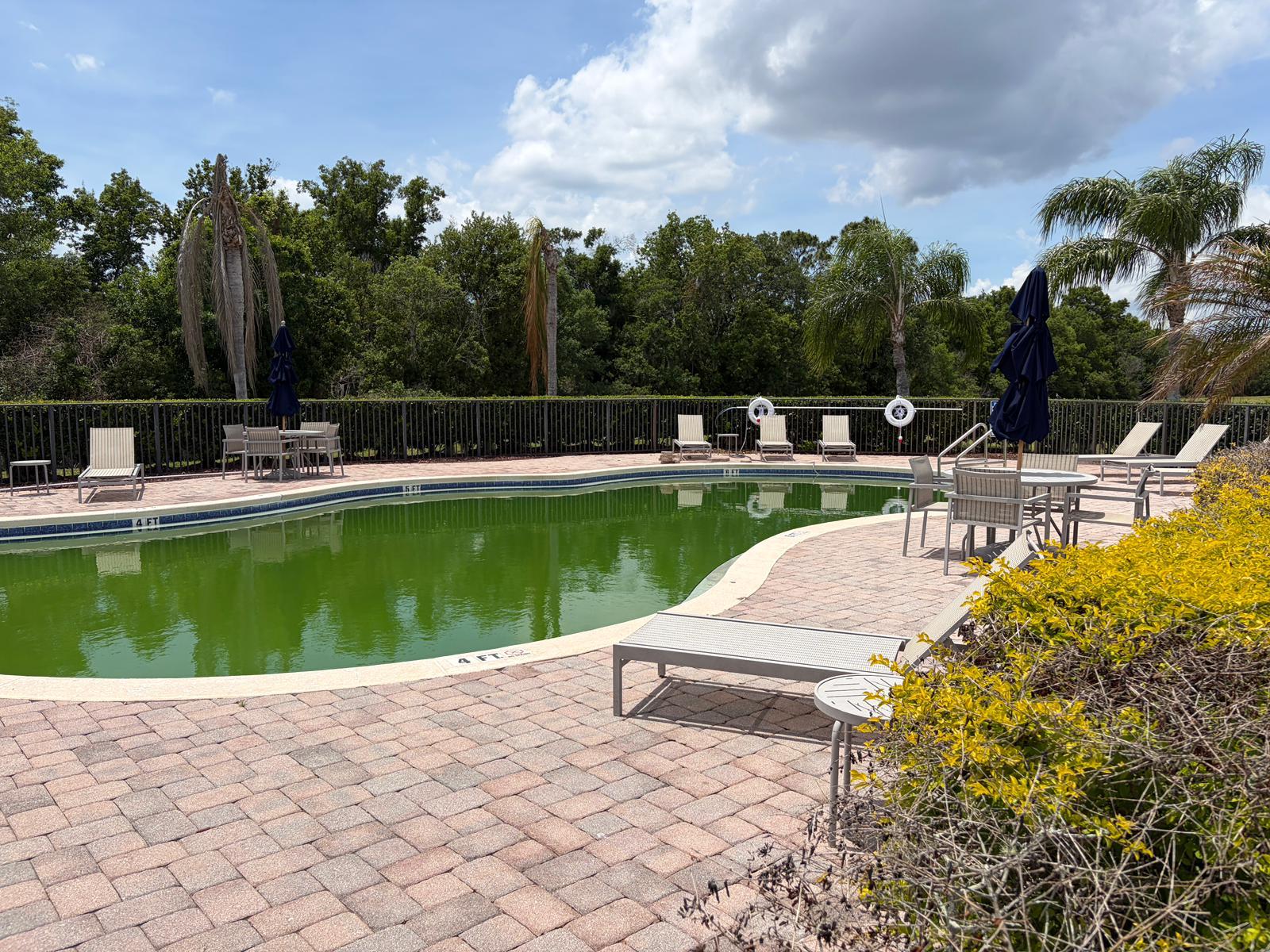
In the meantime, property upkeep, including of the pool, has been neglected, she said. Records show the state department of health has cited the pool several times in recent years, most recently this month, due to violations, including a green color that is also depicted in residents’ photos shared with The Real Deal. The pool was closed, according to the health department’s June 3 inspection report.
Prime Group and its attorneys didn’t respond to inquiries about the claims at Portofino Vista.
“Homeowners are captive to the Prime-controlled HOA, CDD and for-profit clubhouse,” Troyer said.
Read more

Development
South Florida
“Immense shell game”: Aston Martin Residences developer accused of fleecing owners

Residential
South Florida
“Fiefdom” in Sunny Isles: J Milton, affiliates sued over alleged grip on condo association