

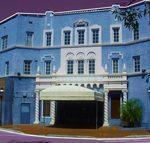
The 100-year-old Coconut Grove Playhouse is a step closer to revival with a scaled-down performance venue, retail, offices and a parking garage after it’s been closed for 20 years.
Miami city commissioners approved Miami-Dade County’s long-debated plan, granting five zoning exceptions and four waivers that clear the way to restore the playhouse’s 1926 façade and build a new 310-seat theater behind it centered around an open-air plaza with 2,600 square feet of retail space, 3,800 square feet of food-and-beverage space, 28,000 square feet of offices, 2,600 square feet of educational space and 289-space parking garage next door.
The plaza would connect the playhouse, at 3498-3500 Main Highway, to the neighboring historically Black West Coconut Grove, or “Little Bahamas” neighborhood, in what the county says will reconnect the once segregated community. But opponents argue the retail and office portions will over-commercialize the site and worsen traffic.
The playhouse historically included commercial space, and the project restores those uses rather than introducing new ones, county officials said. The county will not pay for the operation and maintenance of the site, and the commercial uses are intended to make the project self-sustaining.
While the city commission’s vote cleared a major hurdle for the redevelopment, opponents could still challenge the approval in court, and the county must obtain any remaining permits and satisfy conditions tied to the approval before moving forward with the redevelopment.
As part of the approval, commissioners allowed the county to increase the site’s maximum lot coverage from 50 percent to 62.4 percent, reduce required green space from 30 percent to 14.9 percent, install additional impervious pavement throughout the property and build a 30-foot-wide driveway from Main Highway to access the parking garage.
The green space reduction would be to add sidewalks, which the county said was at the request of public feedback.
The project budget is $58.4 million, including $28.5 million from 2004 Miami-Dade general obligation bonds, $13.4 million from the countywide infrastructure investment program, $9.1 million in 2005 special obligation bonds, $5.4 million in parking revenues and a $2 million grant from the John S. and James L. Knight Foundation, according to Miami-Dade County’s 2025-26 budget.
One sticking point was the city of Miami’s previous commitment to a $10 million contribution, but the county is no longer asking the city to contribute.
The city commission’s vote overturned a recommendation from the city’s Planning, Zoning and Appeals Board, which rejected the application in May after hours of public debate.
Preserve the West Grove and the Coconut Grove Homeowners and Tenants Association were among neighborhood groups that had sought commitments from the county addressing traffic, jobs, neighborhood programming and recognition of the historically Black West Grove community.
The redevelopment has drawn scrutiny from state officials.
The Florida Department of State determined last year that Miami-Dade County’s Coconut Grove Playhouse redevelopment would have an adverse effect on the National Register-listed historic property, directing the county to preserve key architectural features, comply with historic preservation requirements and conduct archaeological monitoring.
State Rep. Fabián Basabe urged city officials to halt the project and announced plans to file legislation to reassign the county’s lease, arguing the redevelopment violates the state’s preservation directives. The county responded saying it had secured and documented historic architectural elements, stabilized the structure and was complying with preservation and archaeological requirements while continuing work on the restoration.
The state-level challenge fizzled in March after Basabe’s bill died in committee without a hearing, returning the project’s fate to local officials.
The playhouse was built in 1926 as the Paramount Pictures movie palace. The Spanish Rococo-style property later became one of Miami’s top regional theaters before it filed for bankruptcy and closed in 2006 after years of financial struggles. The State of Florida acquired the property in 1980, and the City of Miami designated it a local historic landmark in 2005.
Miami-Dade County leased the property from the state in 2013 after the building fell into disrepair and was declared unsafe in 2010. The redevelopment has since been the subject of multiple public hearings, preservation board approvals, appeals and legal challenges over plans to partially demolish and reconstruct the theater.
About a year ago, a partial collapse of the third floor of the building halted demolition work on the historic property, but construction later resumed.
Read more

Development
South Florida
Midtown mixed-use project, Coconut Grove Playhouse overhaul head to Miami board vote

Commercial
South Florida
On hold: Miami-Dade’s partial demo of Grove Playhouse foiled by neighbors
Commercial
South Florida
Miami board votes against Coconut Grove Playhouse redevelopment plan