

Pablo Castro came into South Florida real estate with a bang.
Over the past two years, the Spanish developer, who has never built in the U.S. and until recently had zero name recognition here, proposed Florida’s largest known multifamily complex, bought the site, secured approval and stirred controversy: Castro faces lawsuits by three local industry players who say they were stiffed after playing a role in laying the groundwork for the project.
HueHub would consist of 4,040 units across seven 34-story towers on 12 acres in West Little River. It is planned under the state’s Live Local Act, which allows for bigger projects as long as they include affordable or workforce apartments.
All apartments will be furnished and attainably priced, which exceeds Live Local’s requirement for just 40 percent of units to be at below market rents. It promises a lifestyle usually denied to housing cost-burdened tenants: HueHub’s show kitchens, learning center, fitness studios and other amenities would be free to residents.
“The whole concept isn’t, ‘Hey, I am providing a gym and a pool,’” Castro said. “The whole concept is to provide a quality of life … an elevated quality of life to people and provide a really good, attainable price.”
On blueprints, the vision is ambitious. In court filings, it’s messy.

Laura Tauber, a longtime South Florida investor and developer, sued Castro in March, alleging they partnered on HueHub and that she put in three years of full-time work into it under the understanding that she would eventually be compensated, including with a profit share. But when the time came, Castro reneged on their deal, delayed and avoided conversations about Tauber’s end of the deal and eventually cut her out, after she had secured retail pre-leases and deals with unions and senior housing operators to pre-lease a substantial number of units, according to her complaint.
Under their oral agreement, Castro was to bring the cash, and Tauber her regional experience and connections, which Castro lacked, according to her suit.
“Simply put, before meeting Tauber, Castro was a deer in the headlights of Miami’s complex real estate and development market,” the suit says, asserting that Tauber isn’t the only one he sidelined. “Such is Castro’s modus operandi, receiving a person’s benefit and determining that he has no further use for them.”
On the heels of Tauber’s filing in March, an architecture firm sued Castro, alleging it’s owed $113,600 for its work, and a chamber of commerce also sued, claiming Castro misappropriated its trade secrets and cut it out of any economic participation.
The bad blood is playing out as HueHub stands out as a test of whether one project can singlehandedly put a meaningful dent in Miami-Dade County’s roughly 90,000-unit need for attainably priced housing. And it’s raised questions about its little-known developer, Castro, who seemingly popped out of nowhere and positioned himself as the person who can make it a reality.
So what is Castro’s professional background? How does the newcomer have the capital and confidence that he –– and not one of South Florida’s established names –– can pull off Florida’s biggest Live Local Act project? And why has he drawn this kind of resistance in the region?
South Florida has a reputation for welcoming transplants, as many have come here to make a name for themselves or start anew in a place that generally levies little scrutiny on newcomers and even less judgment.
Castro, 53, says he has done nothing wrong, denies all the allegations, insists he has never even met anyone from the chamber of commerce, and is pressing on.
“I understand that perhaps some locals, they don’t like that an immigrant like me comes here and makes an investment like that in something that is so needed like workforce housing,” he said.
Who is Pablo Castro?
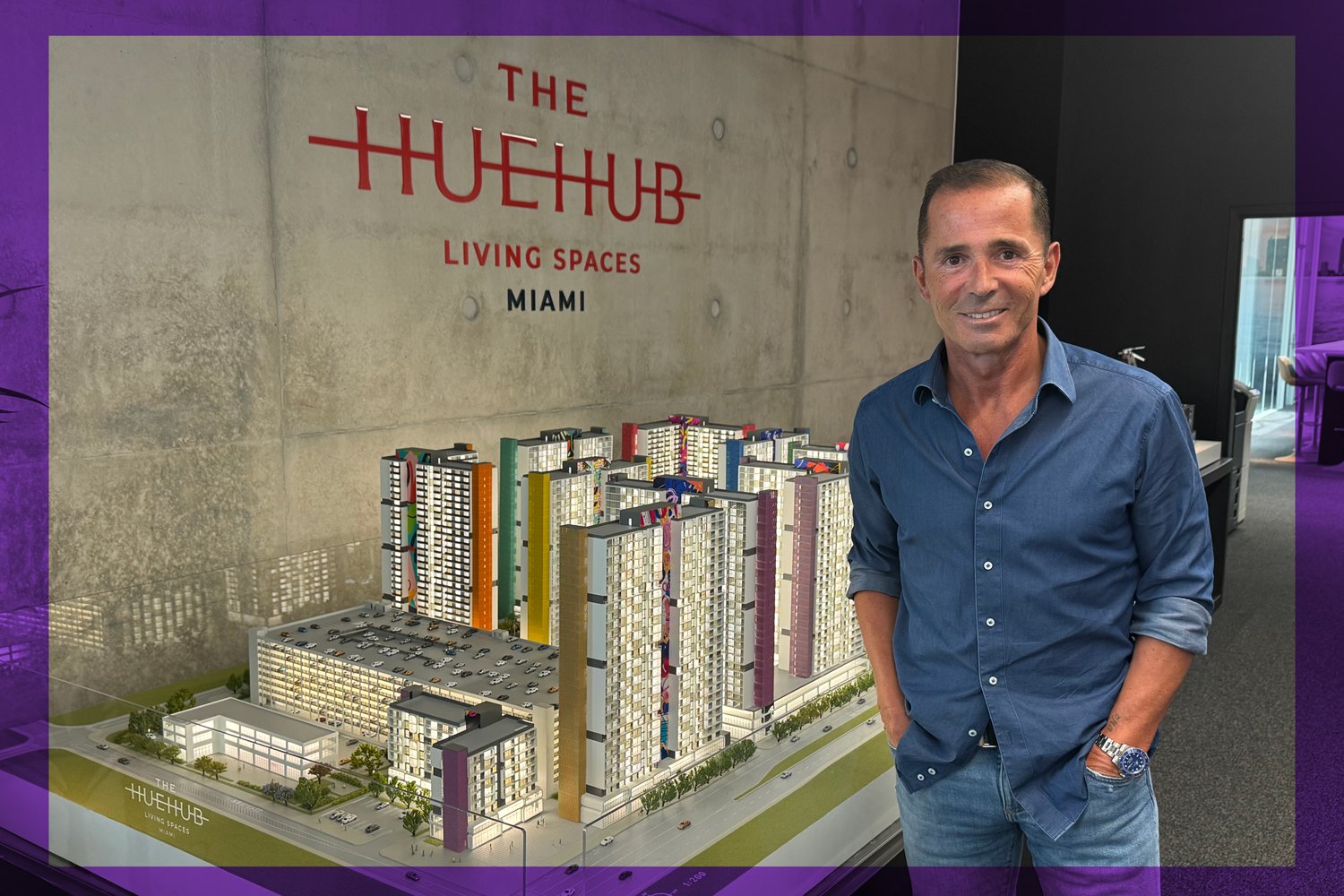
Castro’s full name is Pablo Castro Sáez, with his first name also spelled as Pau in Catalan, as he hails from Barcelona. He is a newcomer to the U.S., but he’s far from a real estate upstart.
He started working for his father, Gabriel Castro Martínez, a hospitality mogul in Spain with nightclubs, restaurants and casinos, at first doing odd jobs as a teen and then managing one of his father’s companies by the time he was 20, Castro said. In the meantime, he earned a law degree and then a master’s in business administration and master’s in real estate law from the University of Girona, he said.
Castro partnered with Pedro Molina Porras in 2007, seizing on the housing crisis to buy development sites at deep discounts and building residential projects.
Specifics about Castro’s work prior to his partnership with Porras, as well as about the pair’s development activity in their first years in real estate are sparse in Spanish media. Castro said that before linking with Porras, he was a developer on his own. Some publications reported that the pair had managed a nightclub together in Mataró, a town near Barcelona, before partnering on real estate.
The published record picks up in 2019 when Castro and Porras partnered with the wealthy biopharma Grifols family on apartment development. Under the joint venture, the duo would contribute the land, and Dutch firm Scranton, controlled by the Grifolses and former executives at their pharmaceutical company, would provide the capital to develop over 2,500 units, according to Spanish publication El Confidencial. Scranton held a 66 percent stake in the JV, and Castro and Porras the 34 percent balance.
It made sense that Corp Promotores would provide the land, with El Confidencial reporting that by 2019 Castro and Porras had become two of the biggest landowners in the Barcelona area.
Castro said his development portfolio in Spain, including through the Grifols JV, consisted of more than 15,000 residential units over 30 years. He and Porras worked through four main entities: BeCorp, through which the pair JV’d with Scranton, as well as Corp Promotores, Corp Construction and Corpedificacions. His real estate ventures raised $338 million in equity and $805 million in debt from 2016 to 2021, Castro said during a recent interview
Regarding projects in Barcelona, Castro provided examples of the 300-unit Can Battló II market-rate apartment complex completed in 2022, as well as the Els Miralls project finished in 2020 with 202 residences, half for-sale units and half market-rate rentals.
Castro divested from his Spanish businesses in recent years, selling his stake in apartments to Porras and other investors. German fund Patrizia bought the multifamily properties developed through the BeCorp-Scranton JV in a deal valued at about $900 million, while Scranton separately bought a 48 percent stake in Castro and Porras’s companies, Spanish reports say.
During an interview at his office in the Miami River District, he pushed back on the lawsuits filed against him this year, saying he had never been sued before coming to the U.S. As proof, he presented attorney letters certifying this.
Spanish court records show that one of his companies with Porras, Corpedificacions, has been involved in litigation with the city of Barcelona over municipal taxes. The city levies a construction, installations and works tax assessed on the construction costs of projects.
In 2021, two of those cases were cleared up with the courts siding with the city. Corpedificacions won a similar case in 2022, and the city was ordered to return an overpayment.
Castro said he no longer held an executive position with Corpedificacions by the time these cases took place and was only a passive investor.
More remains buried under the surface or unknown. North Data, a database for European companies, shows Castro has been tied to 26 entities over the years, mostly listed in Spain but some showing offices in Switzerland and Monaco. (North Data shows Castro is no longer a director of many of these entities.)
Castro explained these are similar to limited liability companies in the U.S. that are used by developers and investors. He added that he has made private family investments in housing in Switzerland and Monaco, but declined to disclose the value of those investments or details.
The Castro family –– including his wife and two children attending Florida International University –– permanently moved to Miami in late 2022, after vacationing in the city for over a decade.
In South Florida, he’s seemingly followed a similar script as in Europe, continuing to make private family investments in stealth mode. Records tie Castro to purchases of nine luxury condo units at the Aston Martin tower and one condo in Brickell Key’s Asia tower in 2023 and 2024 for a combined $17.7 million.
The move to Miami was rooted in personal and professional reasons. Protests in Barcelona tied to the Catalonia independence movement heightened in 2020, Castro said.
“In front of my office –– I used to have a very nice building there for my offices –– they burned the street almost every night,” he said. “It was a mess. … The political situation became unsustainable.”
The government also was taking a “lefty path,” imposing a cap on apartment rents, Castro said, adding that the multifamily portfolio in Spain he had sold off in prior years lost about 30 percent of its value due to the new law.
Go big or go home

The animosity playing out in court between Tauber and Castro has only grown since she first sued in March.
Tauber, who is known locally as a co-lead of Taubco with her husband, alleges her fallout with Castro culminated in a February meeting when she brought her lawyers to the HueHub office, and Castro retaliated by kicking her out and revoking her access to emails and records.
She accuses him of defamation, claiming he has called her a “fraudster” and “extortionist” to other people, and asked the court to sanction Castro, citing testimony by Castro’s former assistant, Francis Reyes, who said that after Tauber was ousted, Castro had Reyes throw away papers from Tauber’s desk, according to court filings.
In court responses, Castro’s attorneys called Reyes a “disgruntled former assistant” who was fired after three months on the job due to performance issues and subsequently received a recommendation letter from Tauber and met with Tauber’s attorneys before testifying.
In fact, Tauber kept few documents on her desk, collected most of them at the end of the February meeting and still had access to the office for two more weeks, Castro said in a signed declaration. He had only asked Reyes to collect and organize Tauber’s papers in a cabinet and denied ordering Reyes to throw away papers.
Although Tauber was initially referred to as a HueHub “partner,” the understanding was that she would bring in capital for the project or contribute otherwise, by bringing in investors –– all things she failed to do, Castro’s camp argues in court.
“Rather, according to [Tauber], she was merely to contribute her ‘expertise and leadership’ and is now entitled to over $130 million,” Castro said in a court motion.
HueHub, he said, is an $880 million project backed by local investors and Castro’s own wealth, he said. He expects to close on construction financing at 60 percent loan-to-cost by month’s end.
The complex will consist of studios starting at $1,300 a month, one-bedrooms at $1,600, and two-bedrooms at $1,800, with the rents for essential workers increasing minimally at 2.5 percent to account for inflation. That’s a reprieve from South Florida’s median rent that as of June was $2,277 a month, according to Realtor.com.
“We can talk about lawsuits, no problem, but I think it’s relevant how important the project is,” he said. “We came here as immigrants to do something to help.”
Read more

Development
South Florida
Unmasking the developers of South Florida’s biggest Live Local Act project

Development
South Florida
3,200-unit project in West Little River marks Miami-Dade’s biggest Live Local Act proposal