

We are excited to announce that Jonathan Miller, who has long authored the most authoritative report on the residential real estate market, is partnering with The Real Deal. Below, you’ll find his Housing Notes column, which will now run on our site several times a week. In addition, Miller’s quarterly report for New York City, which he published through Douglas Elliman for more than three decades, will now be “The Real Deal report, prepared by Jonathan Miller.” Miller’s data venture, Streetmatrix, which provides hyperlocal data, will provide statistics to TRD Data subscribers.
— TRD editors
Lessons to be avoided from Florida property tax plan
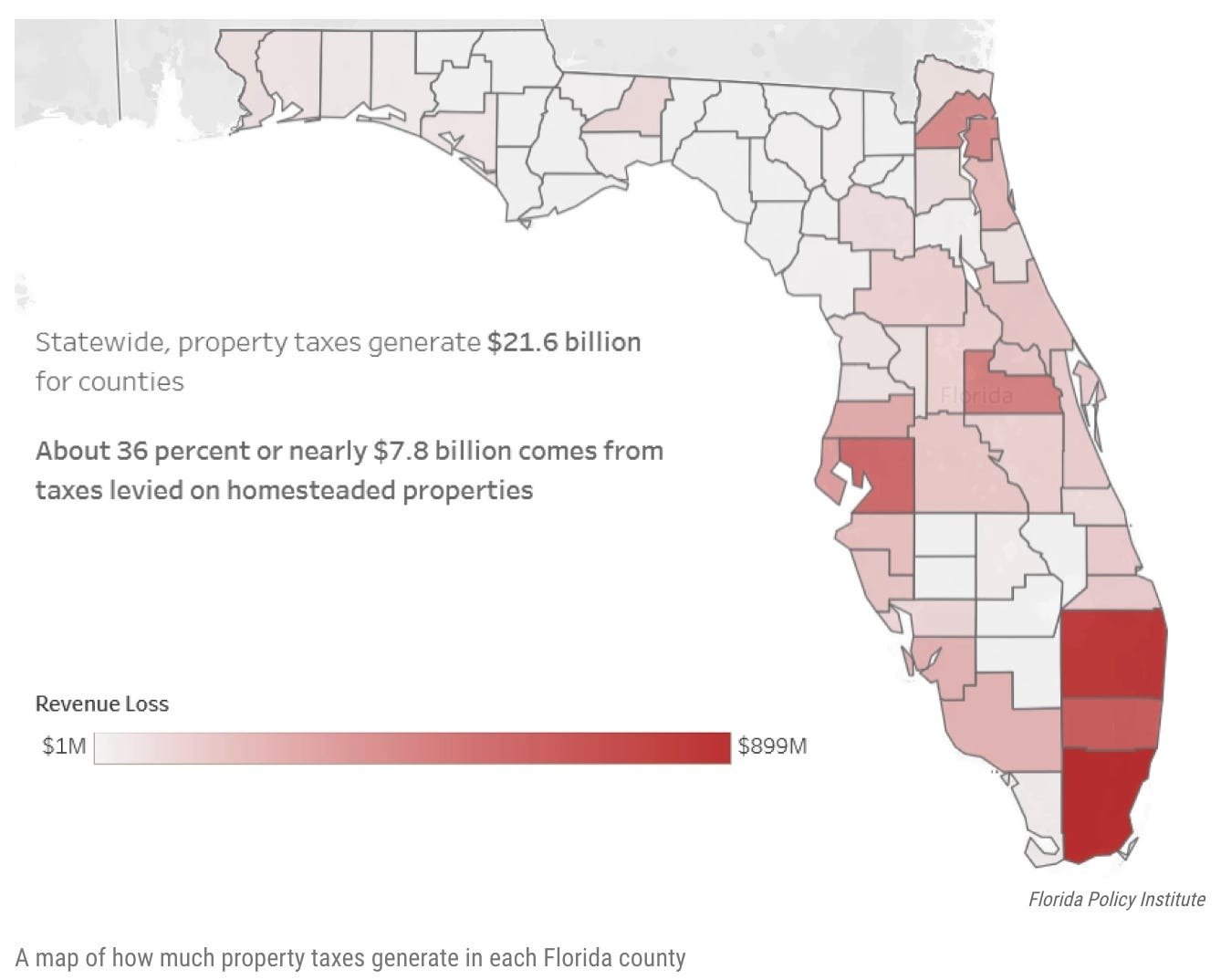
In my life, any conversation about taxes makes my eyelids heavy, and I aspire to watch paint dry, anything to avoid the topic.
Last week, I wrote about the State of Florida’s plan to eliminate property taxes and Tallahassee’s thirst for power and control over the state. Florida’s House of Representatives voted in favor of it, despite it not addressing the details of a needed replacement. Their Senate has yet to vote on it, and if it passes, the bill will be on the ballot in the general election this November.
I brought up the concept of “there’s no such thing as a free lunch” and the lack of any plan to replace the lost revenue with another funding source to finance local government costs, such as police and fire services, and schools. I repeat, there literally is no plan for additional funding sources, despite the favorable vote by the House. This proposal is a direct threat to the quality of life for existing and new citizens of the state. Those in favor of eliminating property taxes think it is a well-deserved gift (a free lunch), but any critical thinking will show it is a threat to the housing market, reducing affordability and increasing uncertainty about basic services, all key considerations in the valuation of property.
Upon further reflection after last week’s post, I decided I needed to do a deeper dive into property taxes and how they stack up against other revenue sources for government spending.
Taxes can be damaging when they change behavior
I often complain here that when a tax plan is created by a city, state or federal government, the authors tend to ignore that human behavior often changes to avoid the tax. We continue to see behavior modification ignored.
If you tax work, you get less work. If you tax sales, you get fewer sales, and so on.
The ideal “least bad” tax targets goods with a fixed supply, like land, because they cannot go away in response to a tax. This is one of my key criticisms of New York City’s pied-à-terre tax.
Land is the most efficient type of tax
Land is inelastic in supply, as you’ve undoubtedly heard, “they’re not making it anymore!” When land is taxed, the impact does not affect its supply because of that quote I just shared. Even when taxing land plus improvements, which is a conventional property tax, a large share of what is taxed is still the land, so there is little distortion to the economy via labor, materials, and businesses.
Because land is immobile and easily observable (perhaps with the exception of Florida swamp land of old dad joke fame), there is far less ability to evade them for legal maneuvering, or profit shifting than with income or corporate taxes, so a municipality can raise revenue with a lower tax rate and less administrative overhead to combat the avoidance.
Property taxes are the dominant source of revenue for local governments and school districts because they are relatively stable year to year compared with income or sales tax bases. This reduces the number of tax hikes or service cuts that would be required to fund income or sales taxes.
The biggest benefit of property taxes as a revenue source for local governments is the much closer link between who pays and who benefits from the services. The clear benefit is that the public can see the investments capitalized back into property values, partly offsetting the burden. Because the tax is highly visible and billed separately, voters can connect tax levels to local service quality, which can help discipline spending without the economic distortions that arise from income and sales decisions. When my wife and I moved out of New York City in 1990 and were researching Connecticut, I became focused on the amount spent per child for each town’s school system. The pattern was quite obvious and determined where we looked first. The more spent per child, the higher the property values, which suggests a better education system.
The problem with property taxes
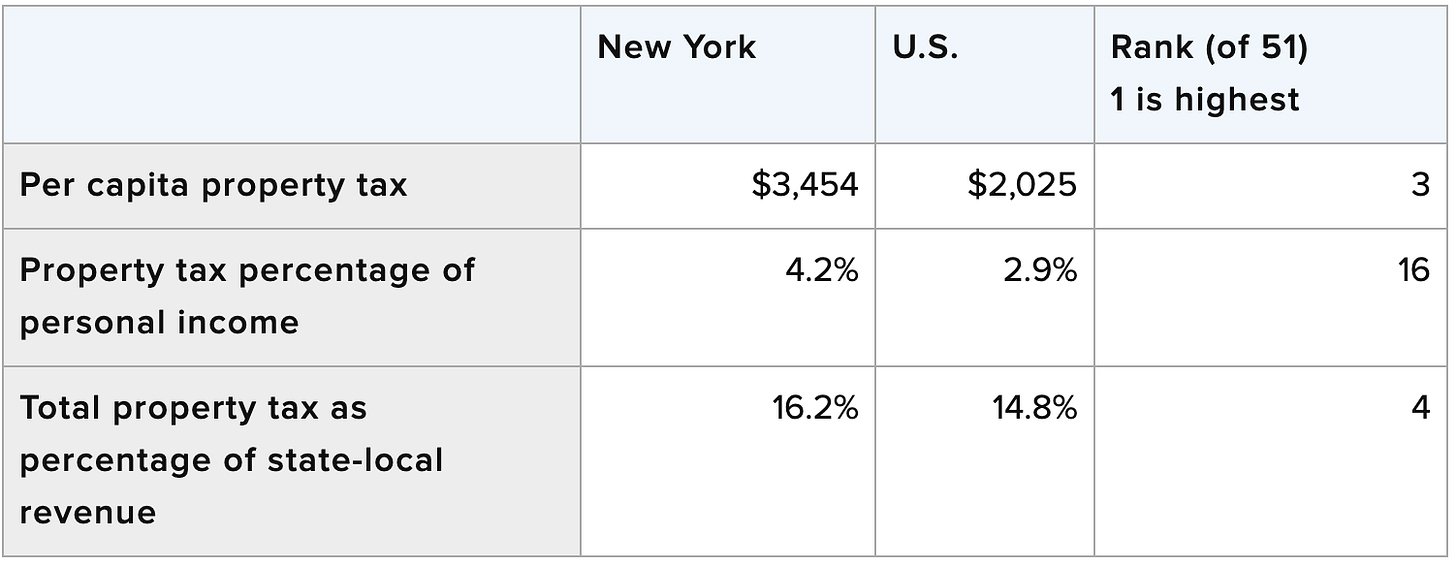
Property tax systems can be regressive and inequitable because of assessment practices, as those in New York City’s convoluted system, which tends to have lock‑ins that benefit older property owners by encouraging lower turnover. New York State has the third-highest property tax rate in the U.S. Florida has the 28th-highest property tax rate in the U.S.
Taxing improvements along with land can discourage dense or higher‑value development, which helps make the case for a land-value-only tax or a system that taxes land much more heavily than improvements.
Flat property taxes can be burdensome relative to income for cash‑poor owners and renters, which is why circuit breakers, such as the homestead exemptions we see in Florida, can be popular.
Why there are zero “no property tax” states
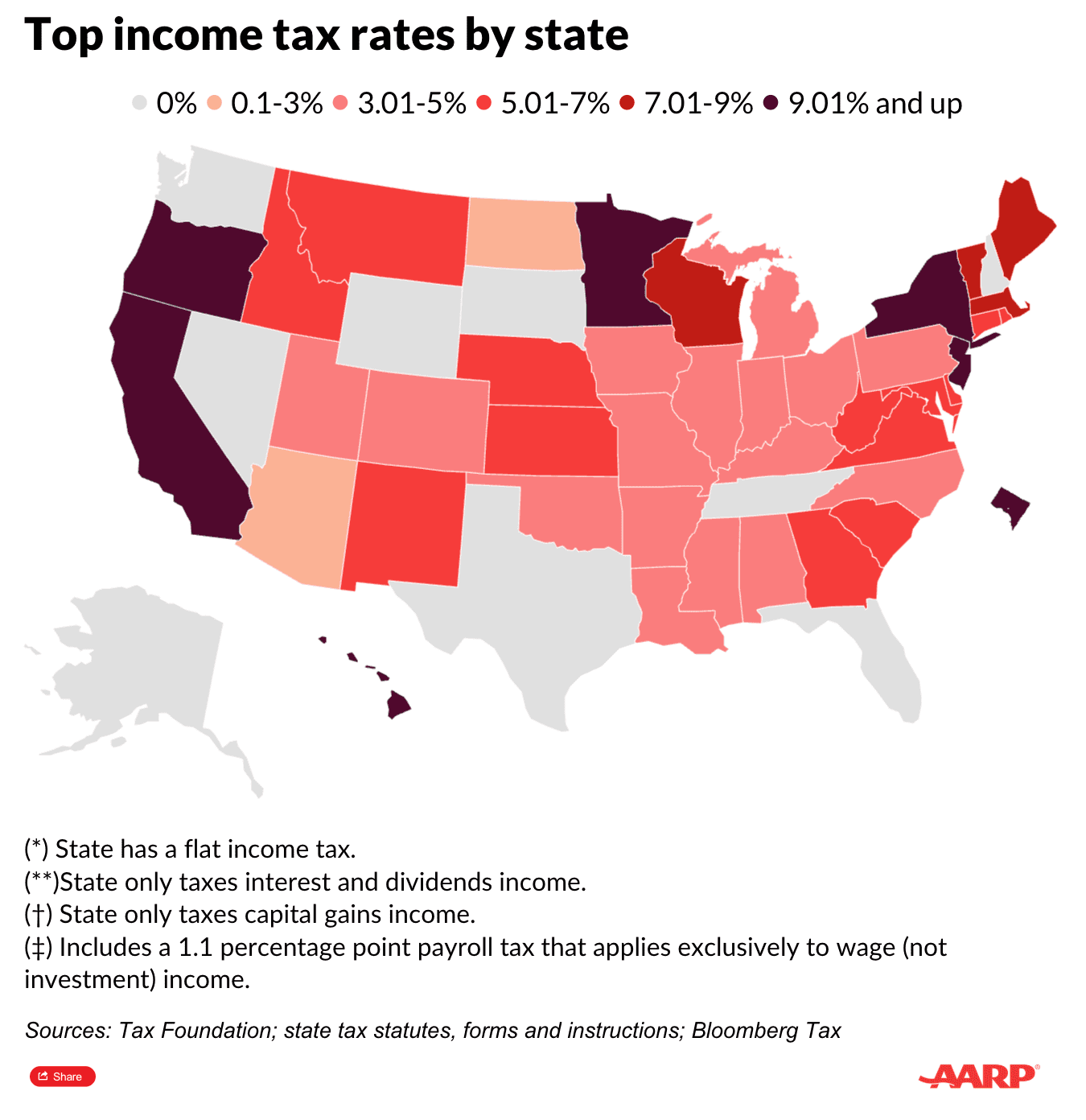
As of 2025–2026, there are nine states with no broad-based personal income tax, but every state in the U.S. levies some form of property tax, usually at the local level.
All 50 states plus D.C. rely on property taxes somewhere in their municipal tax systems, even if the state government itself does not levy a state‑level property tax. Real property tax is primarily a local revenue instrument for cities, counties, school districts and special districts, and states generally allow or require these local entities to levy property taxes to fund K‑12 education and local services. Some states have very low effective property tax rates (for example, Hawaii, Alabama, and Wyoming rank among the lowest), but they are still above zero.
Property tax is deeply baked into the U.S. government’s fiscal structure, especially for school funding and bond issuance, so abolishing it entirely would force a large, politically significant shift to higher state‑level sales or income taxes or to state‑run school finance. In practice, some “no income tax” states explicitly lean more on property taxes to backfill lost income tax revenue, which is why Texas, for example, is noted for high effective property tax rates despite having no state income tax.
Final thoughts
Eliminating property taxes would do more than create a budget shortfall; it would shift power away from local governments to the state and weaken the direct link between taxes, services and home values. By deleting property‑tax bases and then dictating how remaining dollars can be used, their proposed constitutional amendment functionally forces counties and cities to go to Tallahassee for permission and funding to sustain schools, public safety, infrastructure and amenities. This centralizing government control literally has a socialist vibe, as I mentioned in last week’s post. To reiterate that Florida is a small‑government state attempting to create a highly centralized, state-directed tax-and-spend machine that picks winners and losers through Tallahassee politics rather than through local fiscal understanding. They’re going the constitutional route because Florida’s property tax structure lives in the state constitution, and they want the change to be both far‑reaching and hard to undo. Good grief.
No state has done this before, and there are plenty of reasons why they haven’t. That change would make housing markets less predictable, since buyers would have to factor in state-level political decisions rather than local conditions. Replacing property taxes with more volatile revenue sources, such as income or sales taxes, would also make local funding less stable, increasing financial uncertainty and likely placing eventual downward pressure on property values. Over time, that makes the state less attractive to exactly the steady, middle‑ and upper‑middle‑income households that underpin recent success stories of current real estate demand.
The power grab by Tallahassee with this proposal will likely undermine Florida’s positive real estate growth story going forward if it passes this fall.
The actual final thought — NYC needs this, in four.
Read more Housing Notes columns and sign up for email newsletters here.
Read more

Residential
National
Housing Notes: Removing Florida property taxes will reduce housing affordability
Politics
South Florida
DeSantis’ property tax cuts head to statewide vote in November