

With concerns over the health of the private credit market mounting, private credit lenders have increasingly been turning to Collateralized Loan Obligations (CLOs) as a financing tool to deal with a surge of redemption requests and market turmoil, Bloomberg reported.
The commercial real estate industry has been here before, and its experience with distress can serve as a preview for the private credit software and corporate lending world.
CRE’s private lending market went through its surge of CLO issuance in 2021 and 2022.
The niche corner of real estate finance shows how lenders have been flexible working with borrowers and recognizing loan losses — but raises questions about how long they can keep it up.
“Real estate’s already been through its recession when we saw the valuations draw down, when we saw the interest rates hiked,” said Jay DeWaltoff, head of U.S. real estate debt at DWS. “We’ve reached a point where we feel pretty confident we’ve bottomed on valuations. We feel like we’re in the recovery part of the cycle now.”
Why CLOs
Real estate private credit lenders and the CLO market were important backers of the post-Covid lending boom.
CLOs are bundles of loans packaged together and sliced up into different tranches of risk before being sold off to investors.
Unlike syndicated loans where there may be several different lenders who each have a say in workouts, CRE CLO managers exercise complete control over their deals. Most of these CLOs are actively managed, meaning the sponsor buys out troubled loans at risk of default.
Lenders issued more than $45 billion worth of CLOs in 2021 and just shy of $30 billion in 2022.
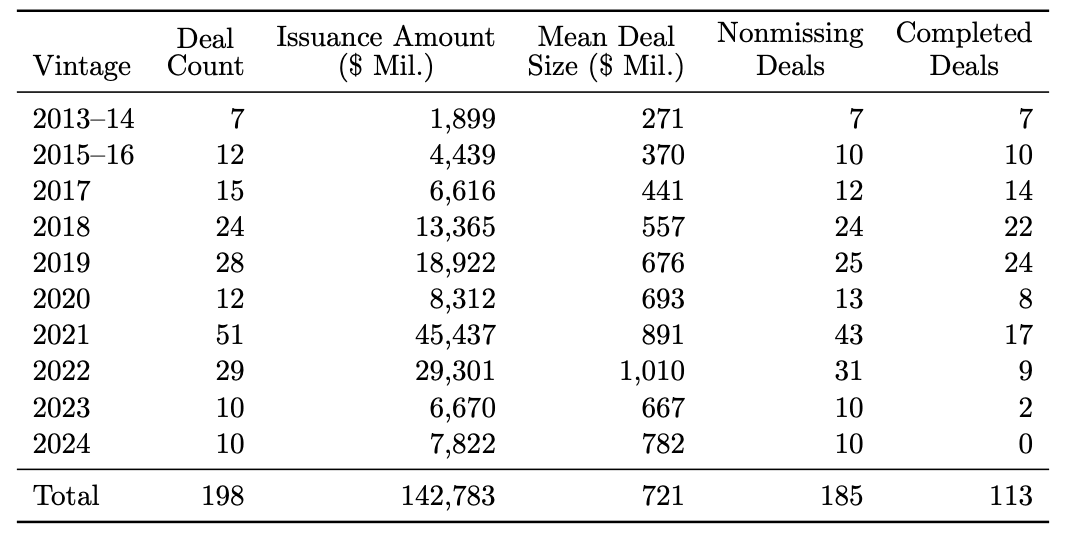
CRE CLO issuance. Source: The Federal Reserve Bank of Philadelphia
The CLOs are filled with bridge loans — like construction loans or debt used to finance renovations on an apartment building — and typically have a term of 3 years with two 1-year extensions. The longest-dated loans from the beginning of the boom are maturing this year and next.
With the perspective of hindsight, researchers found that CLO managers were buying troubled loans out of the securitizations and re-working them on their balance sheets, where there’s less transparency about how they dealt with the debt. Of 6,919 loans across 227 CRE CLOs issued between July 1, 2013, and March 31, 2025, credit ratings agency KBRA found that only 33 loans had reported principal losses, according to a study of defaults and modifications published in July.
But losses on impaired loans ultimately have to be recognized somewhere, which raises the question of how long CLO managers can play the game of buying out bad debt before it becomes unsustainable.
That was the takeaway from a working paper published in December by the Federal Reserve Bank of Philadelphia.
“Our analysis shows that while CRE CLO equity and debt tranches have delivered outsized returns, these outcomes are supported by loan resolutions and servicing actions that defer loss recognition and preserve cash flows to retained interests,” the paper read. “This raises questions about whether performance can be sustained if market stress deepens and distressed collateral must be resolved within securitization trusts.”
(A Fed working paper is preliminary research that represents the views of its authors, and not necessarily that of the Federal Reserve System.)
The Arbor example
One of the biggest issuers of CRE CLOs has been Arbor Realty Trust, which has struggled with distress.
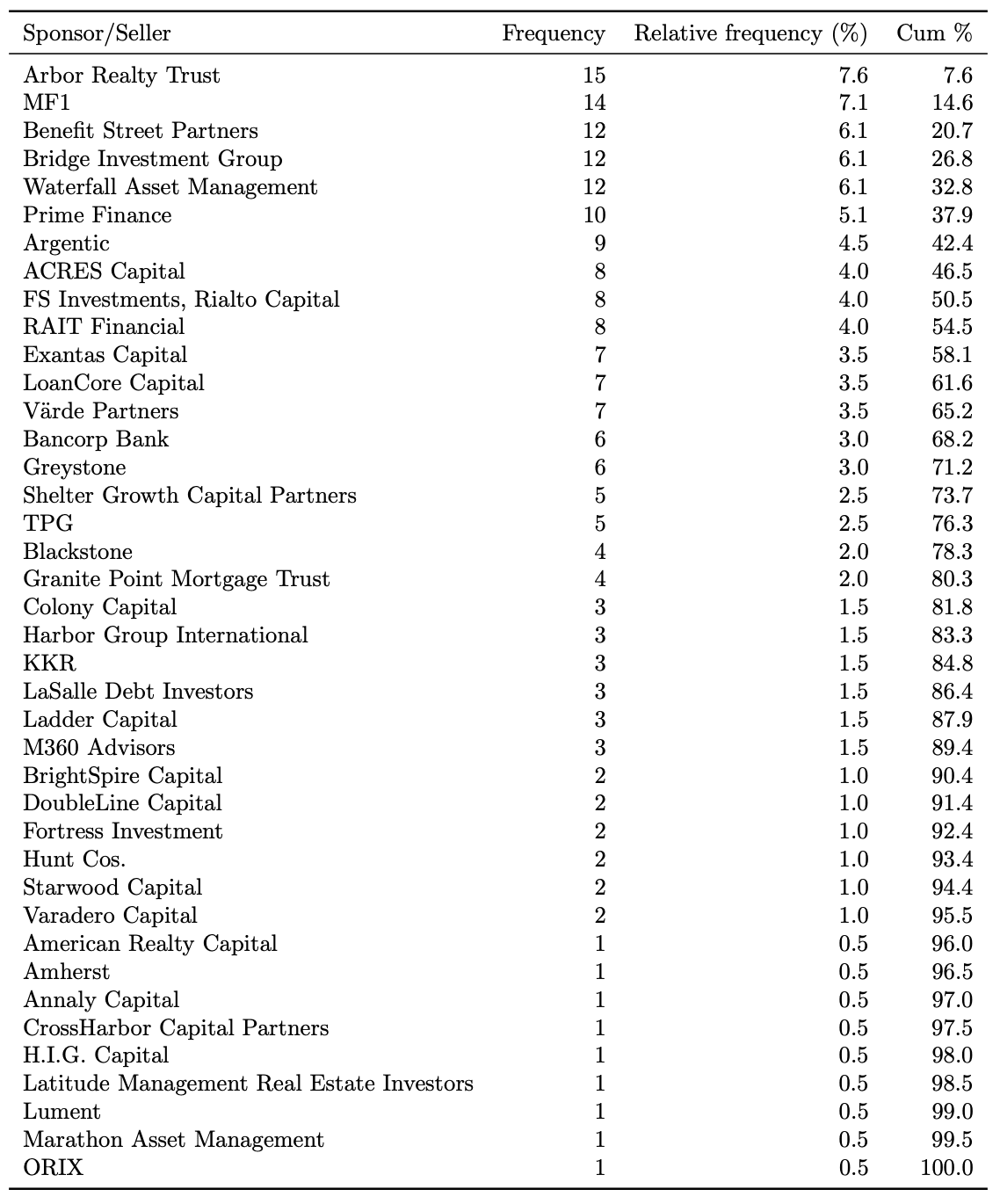
Frequency and relative frequency of distressed loans by Sponsor/Seller. Source: Green Street
The Fed paper looked at one $1.7 billion Arbor CLO from 2021 and found that while 42 of the 59 loans had undergone modifications as of June 2025, only five appraisal reductions, totaling just $18.5 million, had been applied.
That level of reductions would’ve kept the deal narrowly in compliance with the CLO’s overcollateralization test, which is a key measure of the security’s financial health.
“A concern is that sponsors like Arbor may be exercising discretion to delay reappraisals of modified collateral,” the paper said. “Since failure of the OC test diverts interest payments from retained interests to pay down senior tranches and suspends reinvestment privileges until compliance is restored, sponsors have strong incentives to defer formal recognition of collateral deterioration.”
The Fed paper’s authors did some back-of-the envelope math and wrote that the actual impairments on Arbor’s deal could be “orders of magnitude” larger than at first glance.
“If all modified loans in the Arbor deal were reappraised, cumulative appraisal reductions could plausibly exceed $275 million,” they wrote. “Such a write-down would almost certainly cause the deal to breach the OC test and redirect income away from the sponsor’s retained interests.”
A spokesperson for Arbor said the company “adheres to the rules set forth in the contracts governing each CLO, including when to order and receive appraisals, and when to enact reductions in the value of collateral in CLOs.”
“It does not delay obtaining appraisals or when to use them in analyzing potential reductions in value,” the spokesperson added. “Any speculation to the contrary is inaccurate.”
Arbor has felt the impacts of distress. The company’s stock price is down nearly 75 percent from more than $19 in late 2021 to around $5 now. It also reduced its quarterly dividends in the fourth quarter of 2025 and the first quarter of 2026 due to lower earnings.
Company CEO Ivan Kaufman said on the May earnings call that it’s taking longer than expected to work through troubled loans.
“With the recent increase in rates as well as the expectation that rates can continue to remain volatile, we are now predicting a slightly longer time line in resolving these loans,” he said.
Lessons learned
KBRA noted that most of the 2021 and 2022 loans from its study have already been called, and what’s left are mostly deals from 2024 and 2025.
It’s possible that the most troubled loans have already been worked through, and the remaining deals originated in a more stable environment. In other words, CRE CLO managers may have modified their way through the worst of the distress — a lesson that could be applied to the broader private credit market.
DWS’ DeWaltoff said the main lesson he’s taken away from distress in CRE CLOs is that it’s important for sponsors to have strong control when things go sideways and be able to work directly with their borrowers to maximize recovery.
“On the private credit side, that market over the past decade or so has really grown and expanded to close to $2 trillion and I don’t think it’s seen a real negative credit cycle,” he said. “So I think there are a lot of questions in terms of how are lenders going to behave?”
Read more

Commercial
National
Wall Street crowds into niche corner of real estate private credit

Commercial
National
Banks sweeten deals as they vie for private credit’s business