

For years, title company Riverside and law firm Nussbaum Lowinger have been dogged by rumors of mortgage fraud.
Now, a sweeping lawsuit claims the firms orchestrated a years-long scheme involving dozens of fraudulent real estate transactions, misappropriated escrow funds and concealed kickbacks through charitable donations.
Lakewood, New Jersey-based Blueberry Funding and Florida-based lender EADMK filed a lawsuit in New York’s Southern District against Mark Nussbaum, Samuel Lowinger, Riverside and its owners, Shaul Greenwald, Avery Eisenreich and Yoel Zagelbaum, and two former employees to recoup $87.5 million in missing funds that were supposed to be held in the now-shuttered law firm Nussbaum Lowinger’s escrow accounts. Instead, Nussbaum wired money out of escrow accounts to Riverside, so the title firm could facilitate fraudulent deals, Blueberry and EADMK allege.
The legal filings portray Riverside and Nussbaum Lowinger as the architects of a sprawling fraud that used client escrow accounts and 1031-exchange funds to inflate property values, secure oversized loans and siphon off illicit profits. Riverside and Nussbaum Lowinger received kickbacks on each fraudulent deal and laundered some of them through charitable donations, the complaint alleges.
The new filings vastly expand the scope of the alleged misconduct and provide new details about how the transactions were structured and financed. It also raises questions about why prosecutors have not pressed charges against the players involved.
The scheme
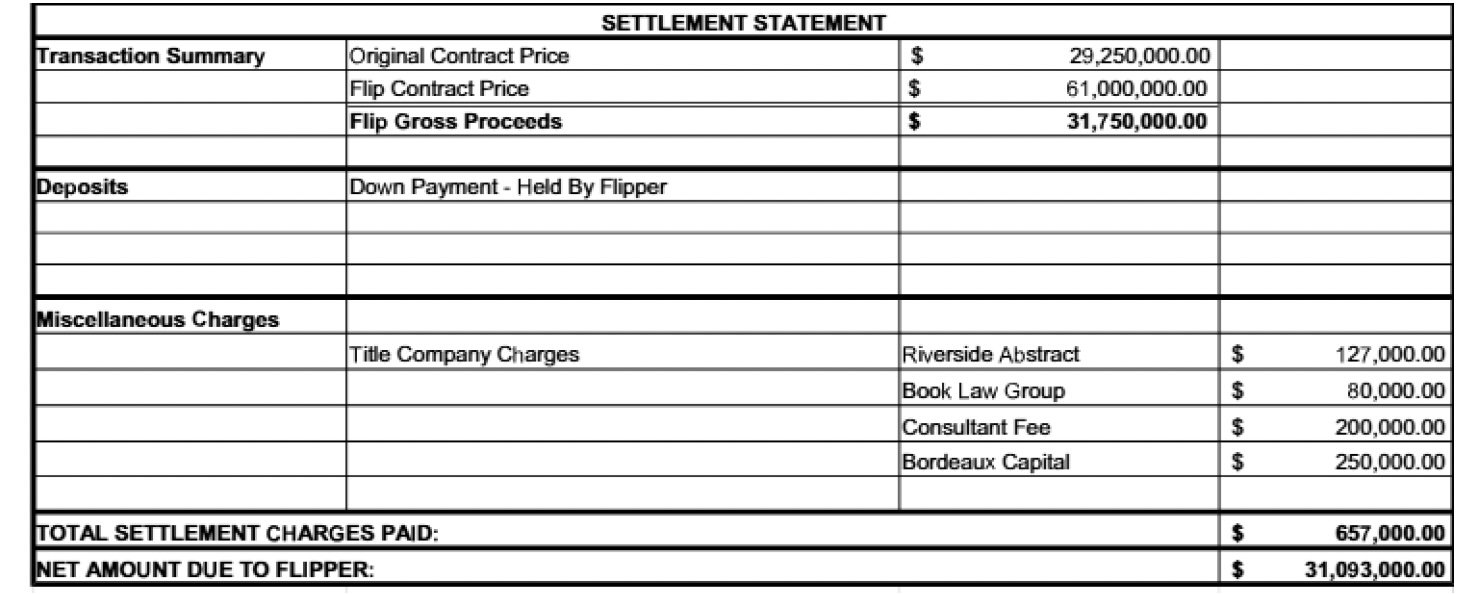
According to the lawsuit, first reported by the Promote, the operation dates back to at least 2018 and followed a consistent playbook: A buyer acquires a property under contract and quickly assigns the contract to a related party at an inflated price. The second sale is entirely fraudulent, the lawsuit alleges. But Riverside acts as the title and closing agent, making the deals look legitimate, though no money exchanges hands, according to sources familiar with the scheme.
The buyer could then solicit a larger loan based on the inflated sale price than would have otherwise have been possible. The participants would pocket the difference between the inflated loan and the actual sales price.
In one example cited by the lawsuit, a buyer acquired a property known as Park at Crestview in Austin, Texas, for about $40.1 million in 2023. The contract was quickly assigned to a new “buyer” for $54 million. The inflated valuation resulted in the lender, Lument Real Estate, providing $42 million to Riverside, Nussbaum, and co-conspirators — almost $2 million more than the real price.
According to the lawsuit, the settlement statements prepared by Riverside also consisted of unusually large fees, including $23,677 to Riverside and a $138,685 “broker fee” to Fortune Capital Group, despite Fortune never serving as a broker on the deal, plus $50,000 to Nussbaum Lowinger for legal fees.
In order to fund the flips, Nussbaum Lowinger and Riverside required constant short-term bridge loans to make the second fraudulent deal appear real. This is where Blueberry and EADMK come in. They allege Nussbaum Lowinger used their escrow money without their knowledge to provide bridge loans.
“The scheme required a continuous supply of new lender deposits in order to operate, as each new closing depended on the funds from the prior closing,” the lawsuit said.
Riverside, Greenwald, Eisenreich, Zagelbaum, Nussbaum, and Lowinger did not immediately return a request to comment.
1031 Exchanges and charity kickbacks
Nussbaum and Riverside’s founder, Greenwald, allegedly created two additional fraudulent schemes to enrich themselves.
Nussbaum and Riverside allegedly used the 1031 exchange program — which allows companies to defer capital gains taxes by reinvesting profits into like-kind properties — to facilitate kickbacks. Under tax law, the initial sales proceeds have to be held by a third party.
According to the lawsuit, Nussbaum directed 1031 exchange clients to Riverside. Instead of holding the money in its escrow account, Riverside lent out the money at 2 percent interest per month. Riverside paid Nussbaum 1 percent per month in interest as a kickback. Nussbaum and Greenwald described the terms of the deal in a December 2021 text exchange.
“I forget our deal on 1031,” Greenwald texted.
Nussbaum responded, “1 point a month I think.” Greenwald said that Riverside was “loaning it out at 2 plus.”
Greenwald and Nussbaum allegedly used charitable donations to cover up their fraud.
Nussbaum himself and Nussbaum Lowinger staff allegedly disbursed some of the proceeds of the fraudulent flips and 1031 deals by writing checks or wiring funds to charitable organizations at Greenwald or Nussbaum’s direction. The donations concealed some of the fees made from the flips and 1031 fraud, according to the lawsuit. Nussbaum and Greenwald’s exact ties to all of the charities are unclear. But it’s clear from the lawsuit and messages that Nussbaum and Greenwald gave explicit instructions about which charities the money should go to.
Those charities included Pomona Jewish Community, Ohr Shlomo Chasidic Center, Chabad of Pomona, Tomche Shabbas of Monsey, Harchava Charitable Fund, Bais Menachem North Miami Beach, and Rofeh Cholim Cancer Society (RCCS), to which payments were directed in the name of “Mark Nussbaum RCCS Hockey,” according to the lawsuit.
In one message, Greenwald asked Riverside to send $5,000 to RCCS, “In honor of Mendy & Chanie Fischer and family for Mark Nussbaum RCCS Hockey.”
A Riverside employee responded, “yes but you need to let them know [the charity] can’t write anything.”
The employee made the request to hide the name of the donor because Greenwald could not issue a written acknowledgement of the donation or it would be viewed as a kickback.
The lawsuit does not explicitly say to what extent the charities may have known about the fraud.
The arrangement began to unravel in early 2025, when Blueberry and other Nussbaum Lowinger clients began asking for their escrow money back. Nussbaum’s business partner Mendel Steiner died by suicide and Nussbaum Lowinger shut down. Today, escrow clients are seeking more than $400 million from the firm. The Manhattan District Attorney’s office charged Nussbaum with diverting more than $15 million in escrow funds. Nussbaum pleaded not guilty. Neither Nussbaum nor his partner, Samuel Lowinger, have faced any charges related to mortgage fraud.
Riverside was blacklisted from Fannie Mae in 2024 for acting as the title agent on a fraudulent flip involving Brooklyn dealmakers Boruch Drillman and Aron Puretz. Riverside has not faced any criminal charges. The company started off in title insurance but branched into 1031 exchange, LLC formation and cost segregation.
The firm’s unofficial motto was “Do whatever it takes.”
Read more
Commercial
New York
Riverside Abstract's dedication to client service may have gone too far

Commercial
New York
Nussbaum Lowinger files for Chapter 11 bankruptcy

National
The mortgage fraud scam exposing broader cracks in small-time commercial lending