
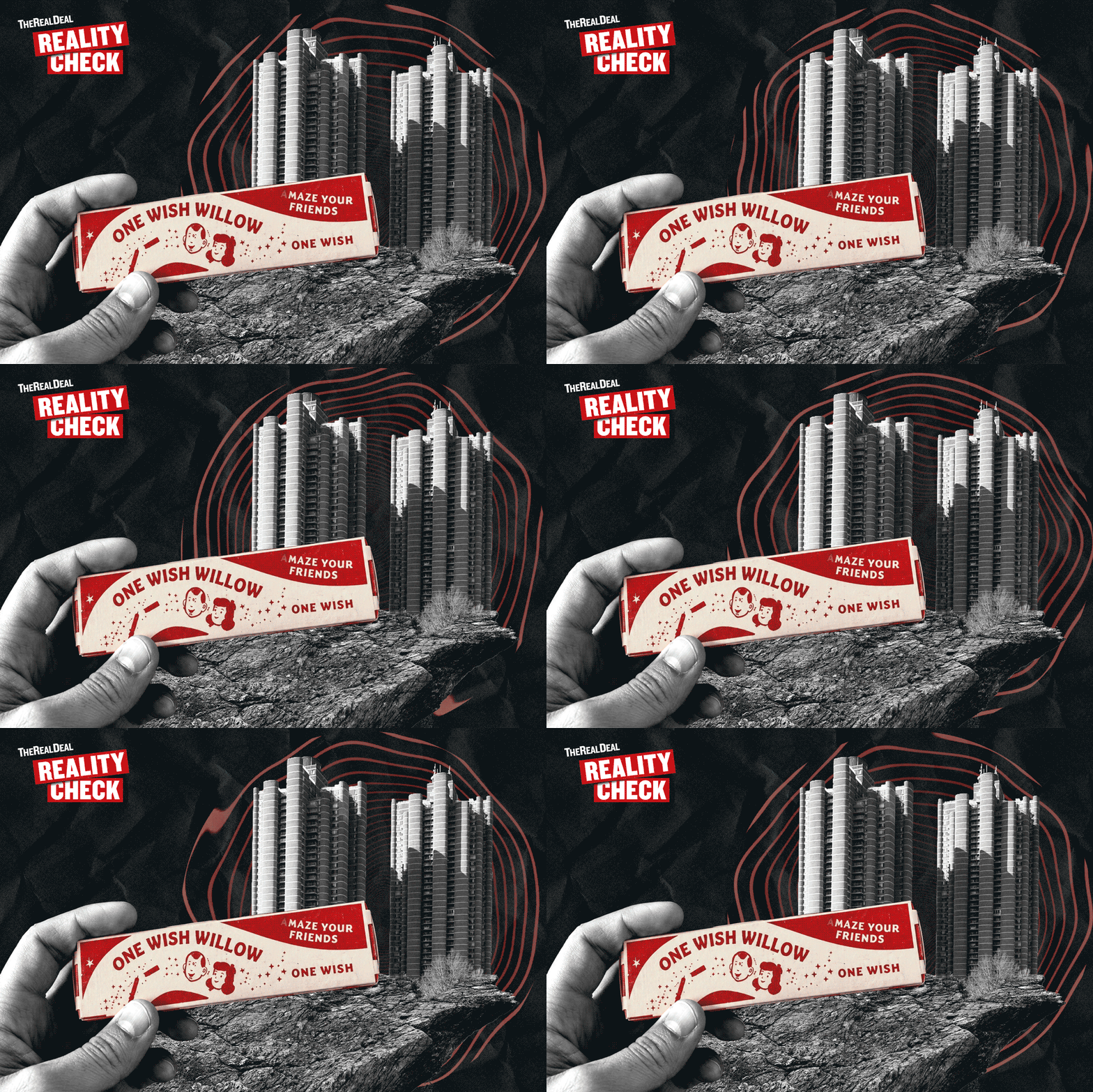
Landlords dream that tenants could spend a day in their shoes, or long enough to realize that ownership is not about sitting on the beach while rent checks roll in.
Tenants also dream about owning their buildings. They aim to pass the Community Opportunity to Purchase Act, plus a state version called TOPA.
What if these wishes came true?
For the answer, we turn to Tracey Towers, an 871-unit complex in the Bronx. Because it’s a Mitchell-Lama, rather than rent-stabilized housing, tenants must pay enough rent to maintain their housing.
The rent increase will be 30 percent over the next four years. Mitchell-Lama co-ops have faced similar challenges.
“Unlike the city’s 1 million rent-stabilized units, many Mitchell-Lama units are facing sharp increases in rents and maintenance costs,” Gothamist wrote. “City housing officials said the city is required by state law to approve a rent adjustment needed to cover a building’s costs.”
The rent must cover the costs. What a concept!
The city oversees 44,000 of the more than 130,000 Mitchell-Lama rentals and co-ops built over two decades under a 1955 state initiative to house the middle class.
It’s a celebrated program, named for the two legislators who created it, but it’s also a time bomb. Residents get used to low rents or monthly fees, deferred maintenance grows exponentially and subsidies run out.
Eventually, the crisis becomes apparent. Then Mitchell-Lama tenants’ rents and co-op shareholders’ maintenance fees shoot up, even more so if they had been underpaying for years.
Tracey Towers’ rents from 2015 through 2024 went up only 2.1 percent per year, on average, even as the buildings crumbled and the mortgage arrears grew to $5.5 million. Water damage from rain and leaky pipes got worse.
Yet tenants didn’t connect the dots between these signs of distress and their cheap rents — generally $1,300 to $2,000 a month. The RY Management and city officials overseeing the complex apparently didn’t tell them this was unsustainable.
Memo to tenants: If something seems too good to be true, it probably is. The rent freeze, for example.
When their costs get out of control, Mitchell-Lamas either lobby the government for a bailout or leave the program and become market-rate housing.
Rent-stabilized tenants, however, are protected by the Cost-Shifting Board, aka the Rent Guidelines Board. These tenants might be feeling good about the freeze, but their buildings tend to be decades older than Mitchell-Lamas. Without new revenue, they may deteriorate even faster.
Still, buildings are buildings. The forces of nature take the same physical toll regardless of which state laws apply. What’s different is who pays.
Rent-stabilized landlords are not happy about the double-standard, but are flagging it to make a point.
“Rent increases are required to keep up with costs in Mitchell-Lamas,” Jay Martin of the New York Apartment Association tweeted. “Private buildings get rent freezes and vacancy control when costs go up.”
Getting back to the ownership dream: Any rent-stabilized tenants paying attention to Mitchell-Lamas won’t want to become their own landlords.
They don’t want to pay the true costs of operating their buildings, especially when the mayor can freeze their rents and implement a strategy to transfer buildings if landlords don’t make repairs.
But these tactics, like the Mitchell-Lama model, are unsustainable. Sooner or later, someone has to pay for the housing.
Read more

Politics
New York
Mitchell-Lama rescue plans — otherwise known as bailouts
Politics
New York
Rent freeze redraws math for New York landlords

Politics
New York
NY Dirt: Here come the rent freeze lawsuits