
For an industry betting that obsolete office towers can help solve the housing shortage, this week’s scare at the former Pfizer headquarters could be a snag.
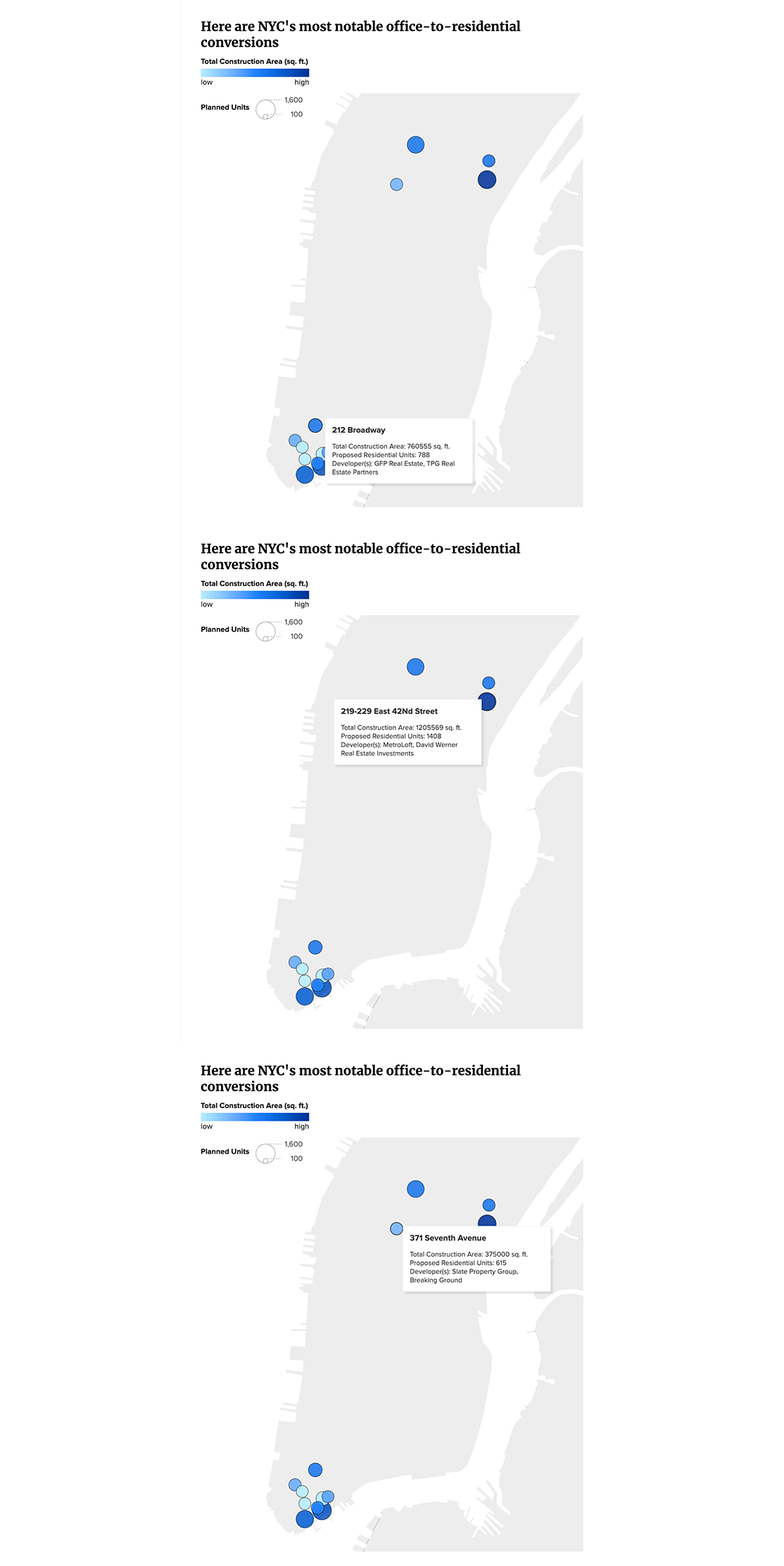
Work stopped at the Midtown Manhattan tower on Tuesday after two steel columns failed during construction, prompting evacuations of the site and neighboring properties. The project, led by Nathan Berman’s MetroLoft and David Werner, is slated to deliver roughly 1,600 apartments, making it one of the city’s most closely watched office conversion projects.
Work was quickly launched to shore up and stabilize the building. Nobody was injured in the incident and Berman anticipates a delay of only a few weeks, sticking to a completion estimate of next year.
The incident immediately put a spotlight on a sector that has become central to New York. As office vacancies remain stubbornly elevated and policymakers push to create more housing, conversions emerged as one of the few ideas capable of addressing both problems at once.
MetroLoft has become the poster child for that movement, assembling a pipeline of aging office buildings primed for residential redevelopment.
The structural failure underscores the risks that come with reshaping decades-old office buildings into apartments. Unlike ground-up development, adaptive reuse often requires developers to cut new cores, reinforce aging structural systems and redistribute building loads, all work that can introduce unexpected complications even on well-capitalized projects.
[Berman described the incident as a “freak accident,” for what it’s worth. Investigations are ongoing.]
The economics behind conversions were already strained by elevated construction costs, expensive financing and the realities of retrofitting buildings never designed for residential use.
A high-profile construction incident could translate into more engineering reviews, tighter underwriting and additional contingency requirements, all of which add time and cost to projects that already operate on thin margins.
None of that is expected to derail the broader office-to-residential push. New York has expanded tax incentives and loosened zoning rules to encourage conversions. The top 13 projects to launch in New York City, all based in Manhattan, will produce more than 11,300 units to the borough across 7.4 million square feet of space, according to a TRD Data analysis of initial alteration filings from 2020 to present.
Mayor Zohran Mamdani, for one, insisted at a press conference Wednesday morning that structural issues with the project aren’t inherent to the complex conversion process. He remains bullish on the category.
So the promise of office conversions hasn’t changed. This week’s events simply reinforced that turning yesterday’s office towers into tomorrow’s apartment buildings is a far more complicated undertaking than swapping cubicles for kitchens.
While reading up on all things Pfizer building this week, you may have missed some of the other big news items. No worries, we’re here to help.
Anthropic finalizes Hudson Square 466K sf building lease as it grows in NYC
Anthropic signed a lease for the entire 16-story, 466,000-square-foot office building at 330 Hudson Street in Manhattan, owned by AEW Capital Management.
The expansion supports Anthropic’s plan to double its New York City workforce to 1,000 employees by the end of the year, with the new space capable of accommodating up to 1,700 workers.
The move follows a surge in demand from AI companies for New York City office space, which has nearly doubled in pace compared to last year and accounts for more than a third of the tech sector’s leasing demand.
Former NYC “worst landlord” strikes a deal, avoids foreclosure
Ved Parkash agreed to sell three distressed properties to avoid foreclosure on those and 21 additional buildings as part of an agreement with Community Stabilization Partners.
The deal requires Parkash to address significant maintenance issues, such as mold and broken elevators, across his remaining portfolio under the oversight of an independent monitor.
The agreement aligns with the administration’s efforts to move struggling rent-stabilized buildings into the hands of more responsible owners, following Parkash’s history of housing violations.
Surprise buyer for Aby Rosen’s “Anna Delvey” building revealed
Airbnb purchased the historic 281 Park Avenue South in Manhattan for $81 million, marking its first office property acquisition in New York City.
The 42,500-square-foot landmark, formerly the Church Missions House and known for its association with con artist Anna Sorokin, will serve as a hub for the company.
This investment signals a long-term commitment to the city despite the company’s significant regulatory challenges, including restrictive short-term rental laws enacted in 2023 that dramatically reduced its local listings.
Grubb Properties lands $377M construction loan for FiDi rental tower
Grubb Properties secured a $377 million construction loan for its 462-unit rental tower at 8 Carlisle Street in the Financial District.
Upon completion, the 64-story project — designed by Handel Architects — is expected to stand 789 feet tall, making it the eighth-tallest residential building in Lower Manhattan.
The financing package includes a $300 million loan from Maxim Capital Group and a $77 million mezzanine loan from Skylight Real Estate Partners.
New York’s luxury new development market is on fire
Manhattan’s luxury market experienced a record-breaking quarter with contracts for new condos priced at $10 million or higher nearly doubling compared to the previous year.
Overall contract activity in Manhattan declined by 17 percent to 311 units, a trend attributed primarily to a shortage of new development inventory, which is currently at roughly three-fifths of its decade average.
While lower-priced buildings are seeing steady absorption, the market’s performance is heavily skewed toward high-end luxury sales, which accounted for half of all deals signed in the city.
Read more

Construction
New York
NY Dirt: Mamdani remains bullish on office-to-resi
Commercial
New York
Here’s a look at NYC’s major office-to-residential conversions

Politics
New York
Buckling ex-Pfizer HQ hit with multiple DOB violations last year