

As wealth and competition abounds, getting into San Francisco’s luxury housing market has perhaps never been more difficult. And now, buyers shopping the listings have to increasingly ask themselves whether they have an extra million dollars in their budget.
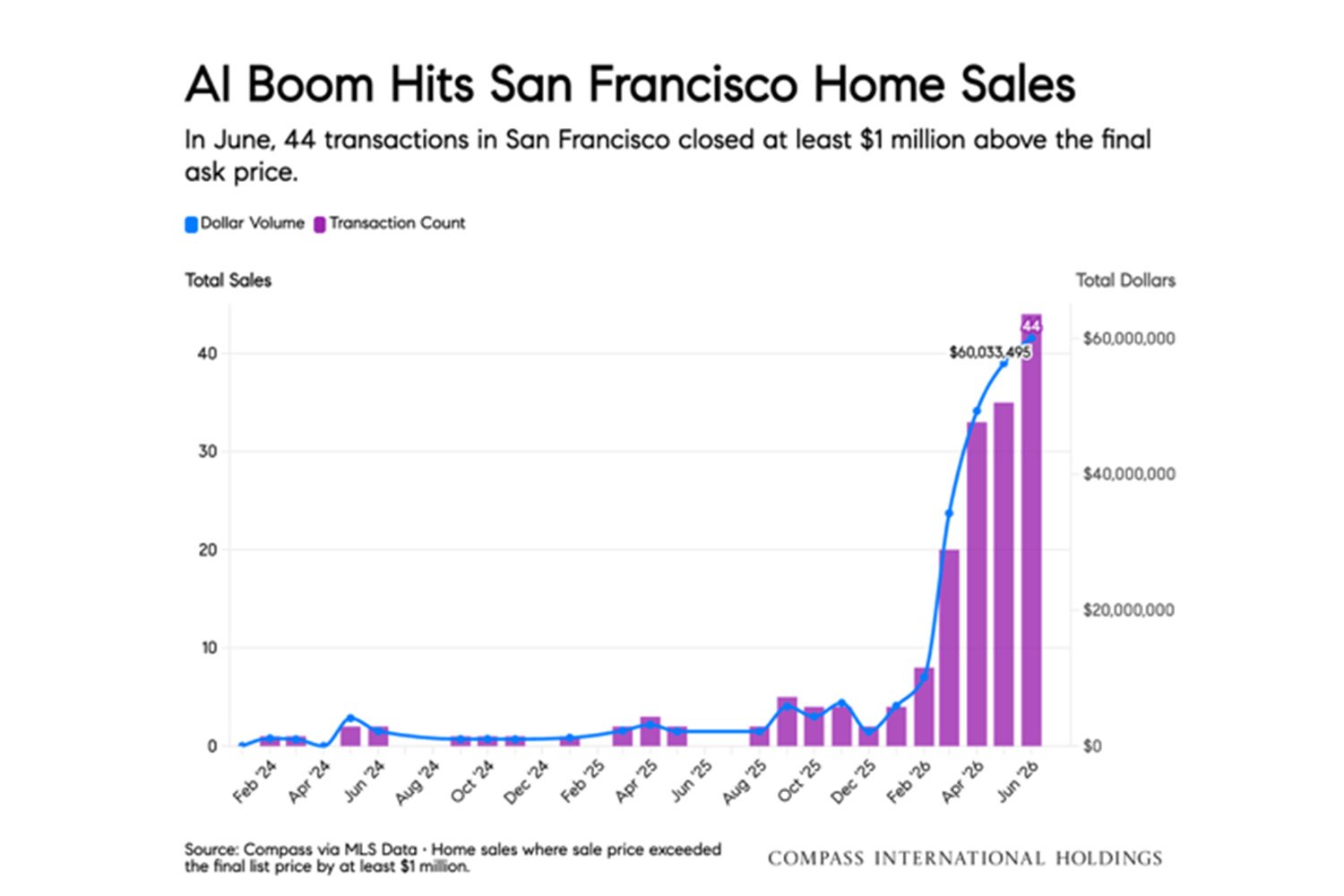
In the first six months of 2026, 144 San Francisco homes sold for at least $1 million over their asking prices, with 44 in June alone, according to a new report from Compass. Only eight such deals happened over that same span in 2025. In 2024, that number through June was six.
“I haven’t seen anything like this,” said Mike Simonsen, Compass International Holdings’ chief economist, who put together the report and has been tracking housing market data for 20 years. He said the amount and power of the demand has been sudden, dramatic and wholly unique.
The homes fetching an additional million dollars over asking in 2026 listed for an average of $3.8 million and sold for an average of $5.3 million, per the report. And some have even scored double their asks. In May, a home on Union Street in the Cow Hollow neighborhood listed for just shy of $8 million and sold for $15 million. In Presidio Heights, a Spruce Street home entered the market for about $4 million and sold for $8.2 million.
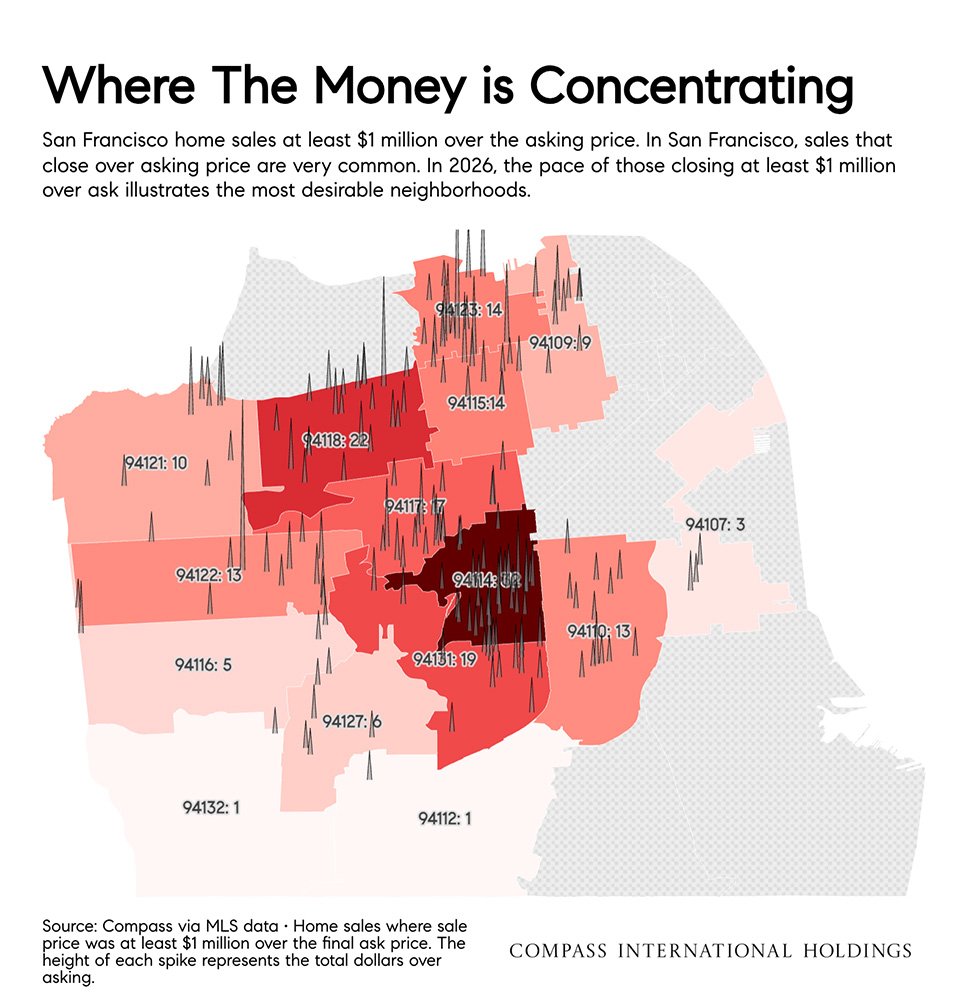
Among San Francisco neighborhoods, the south-central Noe Valley has seen the most of these sales, which Simonsen attributed to its proximity to the Peninsula and Silicon Valley. Presidio Heights and Pacific Heights, the famously wealthy enclaves on the city’s north end have seen the most dramatic overbids, Simonsen said.
Part of this trend is a deliberate pricing strategy that takes advantage of the high demand flooding San Francisco’s scant inventory, Compass agent Erin Thompson said. Her team closed a quick sale on Thursday for a Presidio Heights home that asked $3.8 million and sold for $4.9 million. The property hit the market on June 26 and went into contract by June 29.
Many homeowners who weren’t planning to sell are starting to test the market to see if they can draw a drop-everything price that would convince them to move. Often, Thompson said, they are finding success — and part of it is pricing the home low and triggering a bidding war.
“If you price your home aspirationally and it takes time to sell, then you’re not going to get that magical ‘make me move,’ number,” Thompson said. “Right now, that pricing strategy is working very well on properties that are transacting very quickly. Swiftness is important. The more people [you get] through your home, the more offers, the more money.”
San Francisco is the only housing market west of the Mississippi River with more buyers than sellers, according to a recent Redfin report. Buyers outstripped sellers by 14 percent in May. Meanwhile, in Oakland, sellers outnumbered buyers by more than 30 percent; in Los Angeles, that number rose to 56 percent.
Much has been said about the connection between San Francisco’s flourishing residential market, the wealth wrought by its booming artificial intelligence industry and the number of new millionaires likely to be minted by the forthcoming IPOs by chatbot titans Anthropic and Open AI. However, Simonsen said recent history shows tech IPOs have a minimal impact on San Francisco’s housing market.
Instead, he said soaring local housing prices correlate more to the health of the broader market. When the NASDAQ and S&P 500 reach the kind of record highs seen in 2026, the tens of thousands of San Francisco residents employed by companies like Meta, Google, Apple and Nvidia see a rush of liquid wealth that translates into home buying, Simonsen said.
Still, as the world saw in 2020, those fortunes can turn quickly.
“It’s impossible to time the market,” Thompson said. “The best time for a seller to sell is when demand is high and inventory is low. God only knows what could be right around the corner.”
Read more

Residential
San Francisco
Cow Hollow home sells for biggest gap between asking and closing price in decades

Residential
San Francisco
Forget cash. These Bay Area sellers want AI stock

Residential
San Francisco
AI boom pushes San Francisco median home prices north of $2M