

South Florida real estate money runs through local politics like clockwork, with industry players fueling a share of candidates and political committees’ coffers whenever election season rolls around.
On June 25, many Miamians received a mass text directing them to a website attacking Miami-Dade Circuit Court Judge Mavel Ruiz, the incumbent in this year’s judicial election who most recently made headlines for presiding over the high-profile legal fight over the giveaway of valuable downtown Miami land for President Donald Trump’s presidential library.
“Countless findings. Dozens of reversals. One disastrous record,” read part of the message. The site called Ruiz “Unethical. Unfit. Untrustworthy,” and highlights two past judicial faux pas and a recently filed campaign finance complaint against her.
The text blast was bankrolled by a newly formed political committee called New Vision for Our Courts. Tracing where that committee’s money came from means peeling back layer after layer after layer of PACs, which ultimately leads to recognizable names in South Florida, including many in real estate. South Florida politics news website Political Cortadito first reported on the website campaigning against Ruiz and the chain of PACs funneling money to New Vision for Our Courts.
But there’s a twist: Several of those in the industry who donated to a PAC said they neither knew their contributions could end up funding an attack on a judge, nor did they intend to.
While PACs have to file regular reports on financial contributions, including the name, address and occupation of donors, whether they’re individuals or organizations, as well as the amount they donated, PACs’ chairpeople can transfer money to one another. It creates a chain that murkies the flow of money –– including for the donor themselves.
Ruiz, the incumbent in this year’s judicial elections who has held her seat for two six-year terms, will face off with challenger Destiny Alvarez, an attorney, in the Aug. 18 primary. Judicial races typically are far quieter contests than the competitive, closely watched mayoral and commission elections, with bids for non-partisan Miami-Dade state court judge seats historically hosting little controversy and even less attention. The Ruiz-Alvarez contest has become one of the most unusual in recent Miami-Dade memory, as it’s playing out against the backdrop of Ruiz’s handling of the Trump presidential library deal.
Last year, Ruiz initially temporarily blocked the handoff, siding with Miami activist Marvin Dunn, who had sued Miami Dade College over allegations it violated state open government laws by not giving adequate public notice before voting on the land transfer to the state. The college transferred the nearly 3-acre site valued at about $67 million to the state, and then Gov. Ron DeSantis and the Florida Cabinet donated it to Trump’s library foundation.
After the college’s board of trustees held a redo vote, which had the same outcome of approval, Ruiz in December ruled this cured the alleged transparency issues and dismissed Dunn’s lawsuit, clearing the way for the transfer. Yet, in May, following a filing by the college’s attorneys, an appeals court disqualified Ruiz from any further proceedings in the matter, citing an alleged show of bias after she was seen hugging Dunn when the December hearing concluded and thanking him for pursuing the suit.
The New Vision for Our Courts political committee, formed in May, received $29,000 in contributions.
The Real Deal traced the money trail back through those layers to identify the real estate players whose contributions flowed into the pipeline. Roughly $140,000 of funds from developers, investors, brokers, property managers and contractors has flowed into PACs that then fed into New Vision for Our Courts since May 18, the date the mavelruiz.com domain name was registered. Exactly how much of the real estate money was funneled through the PAC layers and ultimately into New Vision for Our Courts is unclear.
But the layering of PACs shows that industry funds may easily travel from the checkbooks of developers and investors to Miamians’ phones — with little transparency to recipients and funders alike about the flow of money.
Unpacking the matryoshkas
Here’s how the funding structure works: New Vision for Our Courts, which sits at the apex, received $24,000 from Fighting for a Better Miami-Dade and $5,000 from Miami United last month, according to Florida financial records.
While Miami United last received contributions in January, Fighting for a Better Miami-Dade received $24,000 last month from Miami-Dade Residents United –– a PAC that itself branches into three other political committees.
They are Advance Miami, New Leadership for Miami and We Can Do Better Miami, which combined contributed $25,000 to Miami-Dade Residents United in May and June. (Advance Miami isn’t registered in Florida, meaning it may be an out-of-state PAC.)
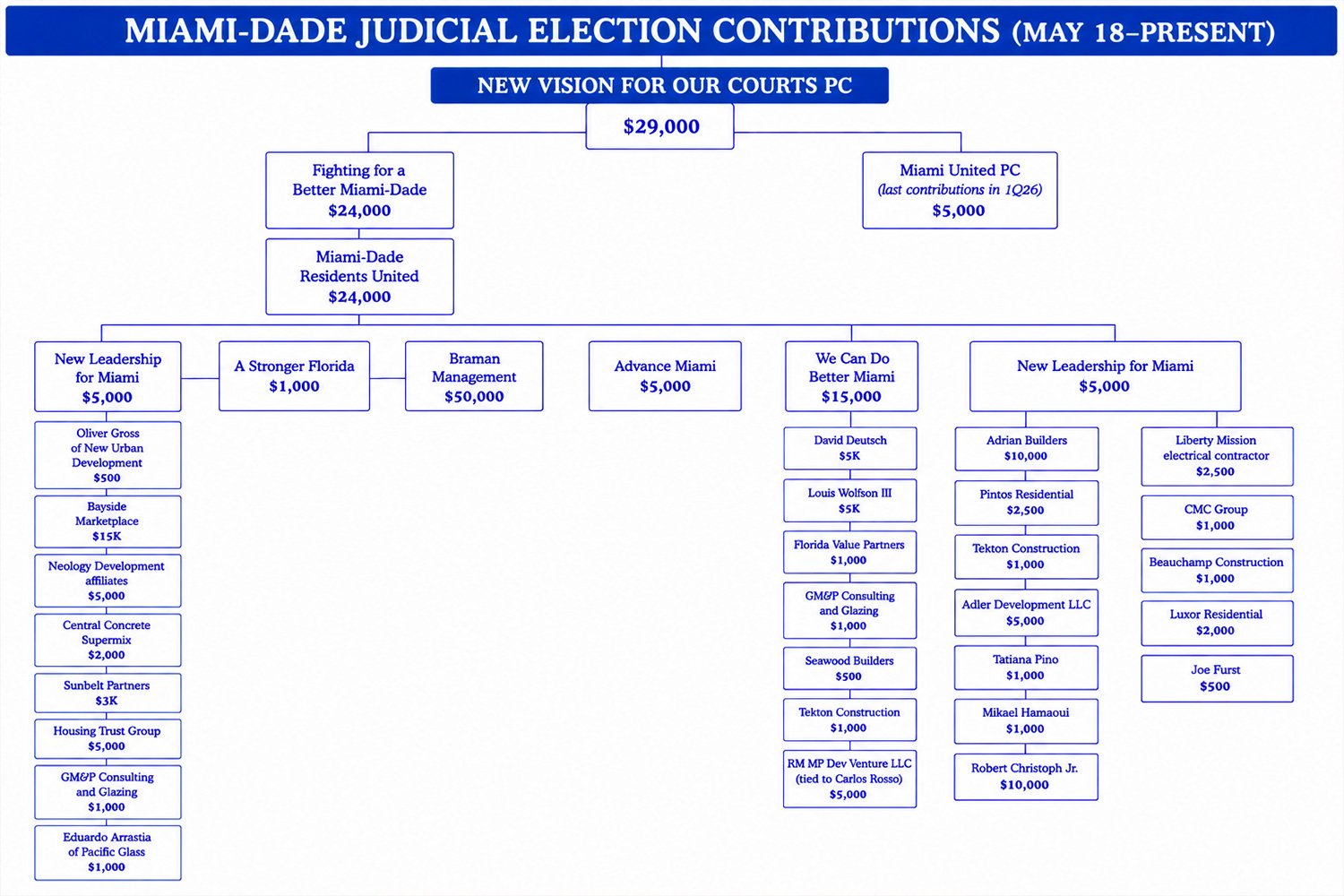
Real estate money specifically flowed into New Leadership for Miami and We Can Do Better Miami.
Braman Management, an entity tied to Braman Miami and billionaire auto dealer Norman Braman, contributed $50,000 last month to PAC A Stronger Florida, which in turn fed $1,000 to New Leadership for Miami, the records show.
Braman has played a role as a hefty political financier for years, including prominently spearheading the 2011 recall of former Miami-Dade Mayor Carlos Alvarez due to his property tax increases tied to the construction of LoanDepot Park, at the time a widely condemned deal by the public.
Braman also has real estate aspirations, last year filing a proposal for a massive project on a portion of Braman Motors’ 21-parcel assemblage in Miami’s Edgewater. The application, submitted under the city’s special area plan zoning provision, called for a pair of 60-story towers with nearly 1,200 residential units and an 11-story auto building.
Bayside Marketplace –– a bayfront open-air shopping and dining venue on a downtown Miami site owned by the city, with New York-based Ashkenazy Acquisition holding the ground lease –– shelled out $15,000 to New Leadership for Miami a day after the mavelruiz.com domain name was created.
Others who added fuel to New Leadership for Miami’s coffers include: Neology Development, a firm led by Lissette Calderon that in recent years built multifamily in Allapattah, gave $5,000 total through five affiliates, and Housing Trust Group also gave $5,000. The other top contributors were Robert Christoph Jr., president of Miami Beach-based RCI Marine, who contributed $10,000, as well as Miami-based residential and commercial builder Adrian Builders, which shelled out a total of $10,000 through 10 affiliated entities, according to state financial records.
RCI Marine is part of a joint venture that will seek Miami voters’ approval in a November referendum to lease 27.6 acres and modernize the Rickenbacker Marina and Marine Stadium Marina.
Smaller contributions to the PAC came from Miami-based family-run Adler Development, which gave $5,000; as well as Tatiana Pino, the estranged wife of late developer Sergio Pino, and Ugo Colombo’s Miami-based CMC Group, with each donating $1,000, according to records.
The We Can Do Better Miami PAC’s most recent donations came from David Deutch and Louis Wolfson III, who are of prolific workforce and affordable housing developer Pinnacle, as well as from an entity tied to developer Carlos Rosso, with each contributing $5,000, state records show.
Wolfson said he contributed to a PAC “with the understanding it was to support the re-election of an elected official.”
But, he added, he “had no knowledge that my contribution would be passed through other PACs to fund this text and website.”
Rosso, who recently paid off a $45 million construction loan for the Standard-branded Midtown Miami condo project he completed with Midtown Development, echoed Wolfson’s remarks, saying his recollection is that he donated to a PAC in support of a specific Miami commissioner but not for any campaigning tied to Ruiz.
“We make a lot of donations to a lot of different organizations but aren’t aware how they spend the money,” he said.
In a statement, Adler Development said it neither has affairs pending in front of Ruiz nor any familiarity with her beyond her outside the court system.
“Similarly, we were not aware of the PAC’s involvement in a campaign against her,” Adler added in the statement.
Braman Automotive, Neology and CMC Group declined to comment, and the remaining donors didn’t respond to requests for comment.
Contentious race
A hefty portion of the website encouraging voters to oust Ruiz is dedicated to snippets from a 2020 Florida Supreme Court approval of stipulated discipline against her and four other Miami-Dade judges.
The supreme court approval was of the Judicial Qualifications Commission’s previous determination of misconduct against the judges over a letter they signed encouraging the Department of Children and Families to grant a $500 million, five-year contract to Our Kids, which was one of two bidders for the child welfare job. After the judges were alerted of an investigation over the letter, they immediately took responsibility.
The anti-Ruiz website is set on black background with white and red text, as well as highlighting in yellow of Ruiz’s disciplinary record tied to Our Kids.
“Judge Ruiz now acknowledges the signing … was inappropriate and crossed the line from being informational to lending the prestige of her position to advance the private interests …” reads a portion of the supreme court stipulation that’s highlighted in the anti-Ruiz website.
Most recently, Ruiz was hit with a pair of election campaign financing complaints, accusing her of accepting a pair of $1,000 contributions from a law firm, as well as a $250 and a $1,000 contribution from an attorney, which is against state law limits of $1,000 contributions per candidate per election. Records show that on June 10, Ruiz returned the excess payments to the law firm and attorney.
Ruiz has raised close to $176,000 since last summer primarily from attorneys, and Alvarez has raised nearly $160,000. Alvarez, whose maiden name is Goede, has had a portion of her campaign coffers funded by MAGA-tied names, including principals of Coral Gables-based lobbying firm Continental Strategy, Florida Bulldog reported. Co-founding partner Carlos Trujillo was appointed to various posts during Trump’s first term, including ambassador to the Organization of American States. The other founding partner, Jesus Manuel Suarez, has represented Trump in civil cases.
Ruiz and Alvarez didn’t return requests for comment.