

Wong Logan Architects is moving forward with plans for a multifamily infill project in the Mission District.
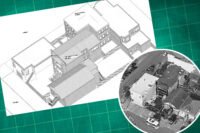
The firm submitted a new application for Trigona, a six-story, 20-unit project at 3230 24th Street featuring some affordable units, San Francisco YIMBY reported. Berkeley-based Wong Logan Architects is listed on project documents as the property owner, applicant and architect.
The proposal is a new iteration of the project that cuts two floors and nearly half of its residential capacity. Wong Logan’s new plans call for a roughly 65-foot-tall building expected to produce 21,970 square feet of housing and 1,200 square feet of commercial space. The 20 units will include two that will be deed-restricted as affordable housing for low-income households; in San Francisco, low-income is generally defined as an annual income of $117,700 for one person or $168,100 for a household of four.
Two retail spaces are slated for the ground-floor space as well as a lobby and parking for 18 bicycles. The site spans roughly 4,400 square feet on a triangular parcel on 24th Street between South Van Ness Avenue and Capp Street, one block away from the 24th Street BART Station.
An estimated cost of the project and timeline for construction has not been disclosed.
With the artificial intelligence boom in San Francisco already exerting pressure on demand for mansions and office space, multifamily developers are looking to meet the need for housing for many workers in the tech sector. In the Mission District, developer Hawk Ling Lou is advancing a project at 2588 Mission Street that calls for a 10-story, 181-unit complex to replace a three-story building burned by a fire in 2015.
The Mission Economic Development Agency and Mission Housing is planning a 350-unit affordable housing development, derided by critics as “The Monster in the Mission,” above the 16th Street BART station.
More than 20,000 units in San Francisco have been approved for construction but are stalled in the development pipeline as developers grapple with rising construction costs, city fees, a shortage of construction materials and federal tariffs. The City of San Francisco is required by the state to entitle 82,069 new housing units by 2030.
— Chris Malone Méndez
Read more

Residential
San Francisco
Contentious SF housing project moves forward in Mission District

Residential
San Francisco
Rubicon Point drops $119M on apartments as AI jobs set to feed market
Residential
San Francisco
More infill resi slated for increasingly dense Outer Mission